

Chemical Reactors Teaching Equipment Service Unit
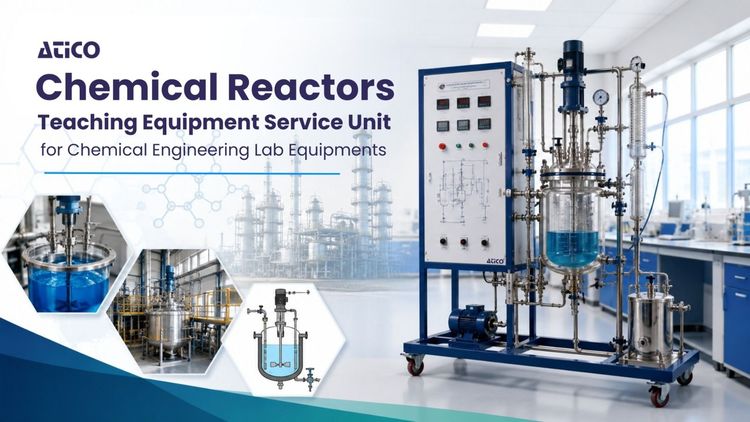
Chemical Reactors Teaching Equipment Service Units are designed to provide practical training in reactor design, operation, and process control. Ideal for chemical engineering laboratories, these systems help students understand reaction kinetics, heat transfer, fluid flow, and industrial process applications through hands-on experimentation.
The Chemical Reactors Teaching Equipment Service Unit is an advanced educational system. These are specially designed to help students understand the fundamental principles of reaction engineering. Chemical Reactors Teaching Equipment Service Unit also helps students in process control and understand chemical process operations through practical experimentation. These are widely used in universities, engineering colleges, technical institutes, and research laboratories. Lab equipment supplied by a reliable Chemical Reactors Teaching Equipment Service Unit manufacturer helps in eliminating the gap between theoretical concepts and real world industrial applications.
As an important component of modern chemical engineering laboratory equipment, the service unit supports various reactor modules. This allows students to study reaction kinetics, flow characteristics, heat transfer, catalyst performance, and process optimisation in a controlled environment. By providing hands on learning opportunities, it improves students' technical knowledge, analytical skills, and understanding of industrial chemical processes.
With advanced instrumentation, real time data, and integrated safety features, the chemical reactor training equipment helps institutions deliver industry relevant practical training while preparing future engineers for professional careers in the chemical and process industries. As a Chemical Reactors Teaching Equipment Service Unit Manufacturer, Atico provides high quality lab instruments for your chemistry lab.
What is a Chemical Reactors Teaching Equipment Service Unit?
A Chemical Reactors Teaching Equipment Service Unit is a specialised laboratory system. It is designed to support and operate various chemical reactor modules used in engineering education and research. It serves as the central platform that provides required instrumentation, process control, and safety functions required for conducting reactor based experiments. The lab equipment allows students and researchers to get practical knowledge and understand industrial chemical processes.
Purpose of a Chemical Reactor Teaching Equipment Service Unit
The primary purpose of a chemical reactor training equipment system is to provide hands on learning experiences that helps in better understanding of theoretical. It allows students to study reaction kinetics, reactor design, process control, heat transfer, mass transfer, and catalyst performance under controlled laboratory conditions. By creating real industrial situation and operations, the unit helps learners develop the technical skills required in chemical and process industries.
How Does Chemical Reactor Teaching Equipment Service Unit Work?
The service unit acts as the operational backbone of a reactor training setup. Chemical Reactor Teaching Equipment Service Unit supplies and regulates process fluids, controls operating parameters such as temperature and flow rate, and collects experimental data through integrated sensors and monitoring systems. Different reactor modules, such as Continuous Stirred Tank Reactors (CSTR), Plug Flow Reactors (PFR), and Packed Bed Reactors, can be connected to the unit for conducting a wide range of experiments. Students can observe process behavior in real time, analyse performance data, and understand how various operating conditions affect reactor efficiency and product conversion.
Key Features of Chemical Reactors Teaching Equipment Service Unit
Below discussed are the key features of Chemical Reactors Teaching Equipment Service Unit.
Advanced Control System
The Chemical Reactors Teaching Equipment Service Unit is equipped with an advanced control system. This system allows users to regulate and monitor critical operating parameters, including temperature, flow rate, pressure, and reaction conditions. This helps students understand industrial process control concepts. It also provides hands on experience with automation technologies used in chemical plants, improves the accuracy and repeatability of laboratory experiments and allows institutions to deliver industry oriented practical training.
Real Time Data Monitoring
The equipment features integrated sensors and data acquisition systems that continuously measure and display process variables during experiments. Students can observe changes in operating conditions and reactor performance in real time. As a Chemical Reactor Teaching Equipment Service Unit Supplier, we provide instruments that supports data driven learning and experimental analysis. These systems allow students to generate graphs, reports, and performance evaluations.
Modular Design
As a Chemical Reactor Teaching Equipment Service Unit Manufacture, we provide high tech lab equipment. A modular design enables the service unit to be connected with various reactor modules, including Continuous Stirred Tank Reactors (CSTR), Plug Flow Reactors (PFR), Packed Bed Reactors, and other experimental setups. This flexibility allows multiple experiments to be conducted using a single platform.
Safety Features
Safety is an important parameter for chemical engineering laboratories. As a Chemical Reactor Teaching Equipment Service Unit exporter, we ensure that the instruments supplied incorporates multiple safety mechanisms such as emergency stop buttons, over temperature protection, pressure relief systems, leak detection, and electrical safety controls. It helps in creating a safe learning environment for laboratory users.
Technical Specifications of Chemical Reactors Teaching Equipment Service Unit
As a Chemical Reactors Teaching Equipment Service Unit Manufacturer, we ensure that our products are made with high quality. Our chemistry lab equipment is designed to provide all essential services required for conducting chemical reaction engineering experiments. The system combines process control, instrumentation, data acquisition, and safety features within a compact laboratory platform.
Construction Material: AISI 304 Stainless Steel framework, tanks, and process components Reagent Tanks: Two stainless steel feed tanks, 5 Litres capacity each Operating Temperature Range: Ambient to approximately 80°C (PID controlled hot water circulation system) Flow Rate Range: 0–118 ml/min through peristaltic feed pumps Feed Pumps: Two variable speed peristaltic pumps Control System: Electronic temperature controller with digital displays and variable speed pump control Temperature Control: Hot water circulation system with electronic thermostat Data Acquisition System: Real time monitoring software with data logging, trend analysis, and process visualisation Instrumentation: Digital conductivity meter, temperature sensors, conductivity sensors, flow control displays Display System: Digital displays for pump speed, stirring speed, conductivity, and temperature measurements Safety Mechanisms: Emergency electrical protection, safety thermostat, ELCB protection, over temperature protection Power Supply: 230 VAC, 50 Hz, Single Phase Power Consumption: Approximately 1 kVA Compatible Reactor Modules: CSTR, PFR, Batch Reactor, Packed Bed Reactor, Laminar Flow Reactor Laboratory Configuration: Bench top modular design Software Features: Real time data acquisition, historical trend analysis, process monitoring, experimental data recording
Construction Material
The service unit is manufactured using high grade AISI 304 stainless steel. This ensures excellent corrosion resistance, durability, and long service life. Stainless steel construction makes the equipment suitable for repeated laboratory use and exposure to various chemical reagents.
Operating Temperature Range
The system incorporates a controlled hot water circulation unit that allows reactor experiments to be conducted at different temperatures. This enables students to study the effect of temperature on reaction rates, conversion efficiency, and reaction kinetics.
Chemical Reactors Teaching Equipment Service Unit: Working Principle
The Chemical Reactors Teaching Equipment Service Unit operates as a centralised platform. It supplies utilities, controls process variables, and collects experimental data for various reactor modules. It allows students to study reaction engineering concepts by conducting controlled experiments and analysing process performance under different operating conditions.
Step 1: System Setup
Before starting an experiment, the reactor module is connected to the service unit and all required process components are checked. The feed tanks are filled with the appropriate reactants or solutions. Then operating parameters such as flow rate, temperature, and stirring speed are configured according to the experimental requirements.
During this stage, students:
- Connect the selected reactor module.
- Fill reagent tanks with prepared solutions.
- Set operating conditions using the control panel.
- Verify sensor calibration and safety systems.
- Ensure all electrical and fluid connections are secure.
This step helps students understand the importance of proper system preparation and process planning before conducting chemical experiments.
Step 2: Process Operation
Once the system is configured, the experiment is initiated. Feed solutions are delivered to the reactor through precision pumps, while the service unit continuously regulates process conditions such as temperature and flow rate.
As the reaction progresses:
- Reactants enter the reactor at controlled flow rates.
- Temperature is maintained using the integrated heating and control system.
- Mixing and reaction processes occur within the reactor module.
- Process variables are continuously monitored by sensors.
- Students observe how operating conditions influence reaction behavior and conversion rates.
This stage provides practical exposure to industrial reactor operations and process control techniques used in chemical manufacturing facilities. It is important to choose the right Chemical Reactors Teaching Equipment Service Unit Manufacturer for efficiency in this step. High quality lab equipment makes the process smooth.
Step 3: Data Collection
During the experiment, the service unit gathers real time process data through integrated instrumentation and monitoring systems. Various parameters are measured and displayed throughout the reaction process.
Typical data collected includes:
- Temperature readings
- Flow rates
- Conductivity values
- Reaction time
- Concentration changes
- Conversion efficiency
The data acquisition system records these measurements for further evaluation. This allows students to track process performance and identify trends throughout the experiment. You must choose the right Chemical Reactors Teaching Equipment Service Unit Supplier for accuracy and precision in each step.
Step 4: Analysis and Interpretation
After the experiment is completed, the recorded data is analysed to evaluate reactor performance and understand the underlying reaction engineering principles. Students compare experimental results with theoretical predictions and calculate key performance indicators.
Common analyses include:
- Reaction rate determination
- Conversion calculations
- Residence time distribution studies
- Temperature effect analysis
- Reactor efficiency evaluation
- Process optimisation assessment
By interpreting experimental results, students gain a deeper understanding of chemical reaction kinetics, reactor design, process control strategies, and industrial process optimisation.
Experiments That Can Be Performed
The Chemical Reactors Teaching Equipment Service Unit supports a wide range of practical experiments. These experiments help students understand the principles of reaction engineering, process control, reactor design, and chemical process optimisation. By connecting different reactor modules to the service unit, learners can investigate how operating conditions influence reactor performance and reaction outcomes.
- Reaction Kinetics Study
- Continuous Stirred Tank Reactor Performance Analysis
- Plug Flow Reactor (PFR) Characteristics Study
- Residence Time Distribution (RTD) Analysis
- Effect of Temperature on Reaction Rate
- Conductivity Based Reaction Monitoring
- Reactor Conversion Efficiency Evaluation
The experiments performed using the Chemical Reactors Teaching Equipment Service Unit provide students with practical exposure to reaction engineering concepts that are widely used in chemical, petrochemical, pharmaceutical, environmental, and process industries. As a Chemical Reactors Teaching Equipment Service Unit Exporter, we supply high quality lab equipment worldwide.
Trusted Solution for Modern Chemical Engineering Laboratories
By combining high quality construction, industry standard components, flexible customisation, expert technical support, installation assistance, professional training services, and dependable warranty coverage, our Chemical Reactors Teaching Equipment Service Unit provides a complete solution for practical chemical engineering education and research.
Whether your goal is to improve laboratory learning, support advanced research, or develop industry ready engineering graduates, our system delivers the performance, reliability, and educational value required by modern institutions worldwide. Contact with our team today.