

Loading product…
Loading product…
Need Help?
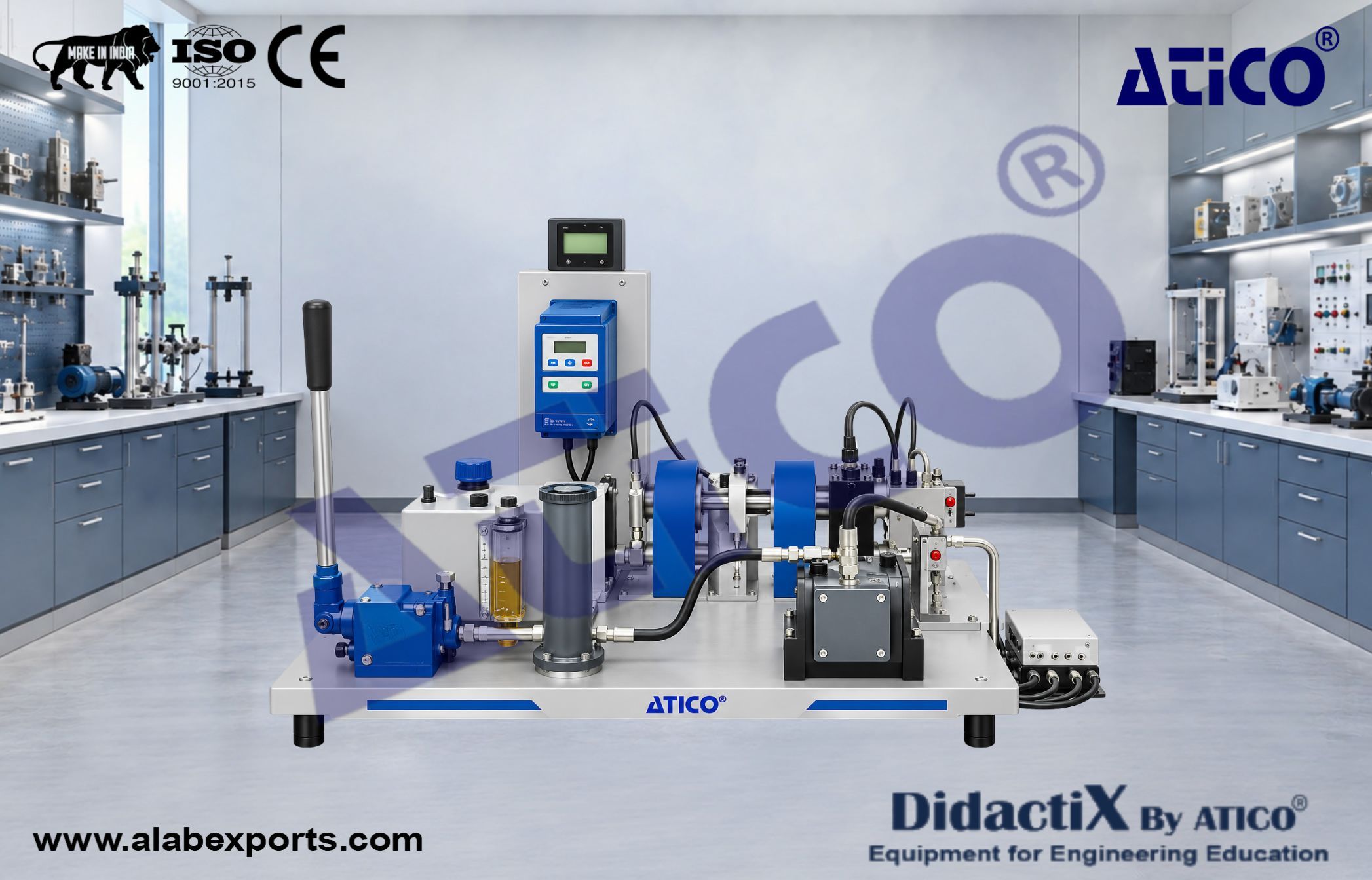
+91 98967 93832The Bearing Prognostics Simulator is an innovative research system designed to study bearing wear and model the evolution of bearing damage. It features specialized transducers for measuring bearing friction torque and transverse and axial loads applied to the bearing. The system operates in three software-selectable modes: constant rotational speed, purely oscillatory motion and oscillatory excitation superimposed on rotation.
Experiments can be performed on rolling element bearings, pressurized fluid-lubricated bearings and grease-lubricated bearings. The friction torque and load transducers provide valuable data for understanding bearing prognostic signatures and modelling bearing failure mechanisms. The system supports the development of predictive models for estimating bearing remaining life based on routine condition monitoring measurements.
The torque transducer is sensitive enough to measure small bearing friction resistance under several thousand pounds of transverse or axial load. A fluid film lubricated support bearing arrangement is also available to minimize unwanted vibration and noise. Higher rotational speed and loading configurations can also be provided.
Manufactured by Atico Export with a focus on precision, durability and consistent performance in mechanical engineering research and testing applications.
A smart design for performing accelerated run-to-failure tests :
Bearings are critical components of rotating machinery. Unexpected bearing failures can result in costly downtime, production losses and irreversible machinery damage. Conventional condition monitoring programs routinely measure bearing vibrations and analyze vibration signatures to assess bearing health and damage severity.
However, assessments based only on historical data and statistical analysis may lead to incorrect predictions, premature bearing replacement and unnecessary production losses. The Bearing Prognostics Simulator addresses these challenges by providing an accelerated run-to-failure testing platform with specialized transducers for measuring important bearing parameters.
Benefits :
Instrumented loading system for measuring applied force :
The Bearing Prognostics Simulator is designed to hydraulically load bearings in both transverse and axial directions. Tests can be performed to observe damage initiation and propagation in different types of bearings.
The system operates in three different modes:
A PC-programmable variable-frequency AC induction motor provides rotary motion up to 6,000 rpm. A higher-speed version is also available. A software-configurable stepper motor is used for oscillatory motion or low rotational speeds ranging from 10 to 180 rpm. Both motors can be easily and interchangeably mounted on the simulator platform.
The test bearings are arranged in an overhung configuration and supported by two rows of heavy-duty rolling element bearings. A fluid film support bearing system is also available. This arrangement facilitates easy bearing loading and measurement of friction torque generated during testing.
An instrumented hydraulic system is provided for axial and transverse loading. It consists of an oil reservoir, oil valve, hand pump, pressure gauge, load transducer and loading cylinder. Radial loads up to 6,000 pounds (approximately 27 kN) can be applied to the bearing housing. A force transducer positioned between the loading cylinder and test bearing housing measures the applied force.
The strain-gauge-based force transducer is designed to measure applied forces and perform signature analysis during bearing wear progression. Its adjustable orientation and application point allow the load to be applied along the bearing centreline, which is particularly important under increasing loads.
Ideal tool for characterizing bearing friction torque :
As bearing damage progresses, the characteristics of frictional forces between rotating and stationary bearing components change. The specialized bearing friction torque transducer is designed to measure these changes.
The transducer incorporates a design that compensates for torque associated with bending forces and minimizes the effects of the supporting structure. Field adjustments can also be made to eliminate the effects of increased lateral loading on support deformation.
This arrangement enables measurement of bearing friction torque as a function of damage progression. The collected results can be used to characterize bearing failure mechanisms and develop predictive prognostics models.
Heavy-duty and easily configurable design :
The simulator is designed for easy installation and removal of test bearings. It accommodates different types of rolling element bearings, fluid film bearings and grease-lubricated bearings. A complete oil circulation system with pump is provided for experiments involving fluid film bearings.
The robust construction provides substantial lateral stiffness to minimize support deformation when several thousand pounds of force are applied to the test bearing. The bearing housing is designed for convenient installation and removal of bearings. Mounting provisions are available for installing different transducers. The simulator frame is mounted on vibration isolators to minimize the transmission of environmental vibrations.
Transducers and data acquisition :
Accelerometers can be installed on the bearing housing to measure vibrations in all three directions. Thermocouples can be attached to the outer race of the bearing for temperature monitoring and analysis. Oil debris can also be collected for lubrication and bearing condition analysis.
Additional transducers can be installed according to experimental requirements. Data acquisition hardware and software are available for performing time-domain and frequency-domain signal analysis.
Mechanical :
Support shaft :
Test bearing :
Hydraulic loading :
Foundation :
Physical specifications :
Weight :
Dimensions :
Ac motor electrical specifications :
Motor :
Drive :
Rpm range :
Tachometer :
Voltage :
Stepper motor electrical specifications :
Motor :
Drive :
Rpm range :
Voltage :


