ATENG 12121 — Comprehensive Mechanical Vibration Analysis Unit
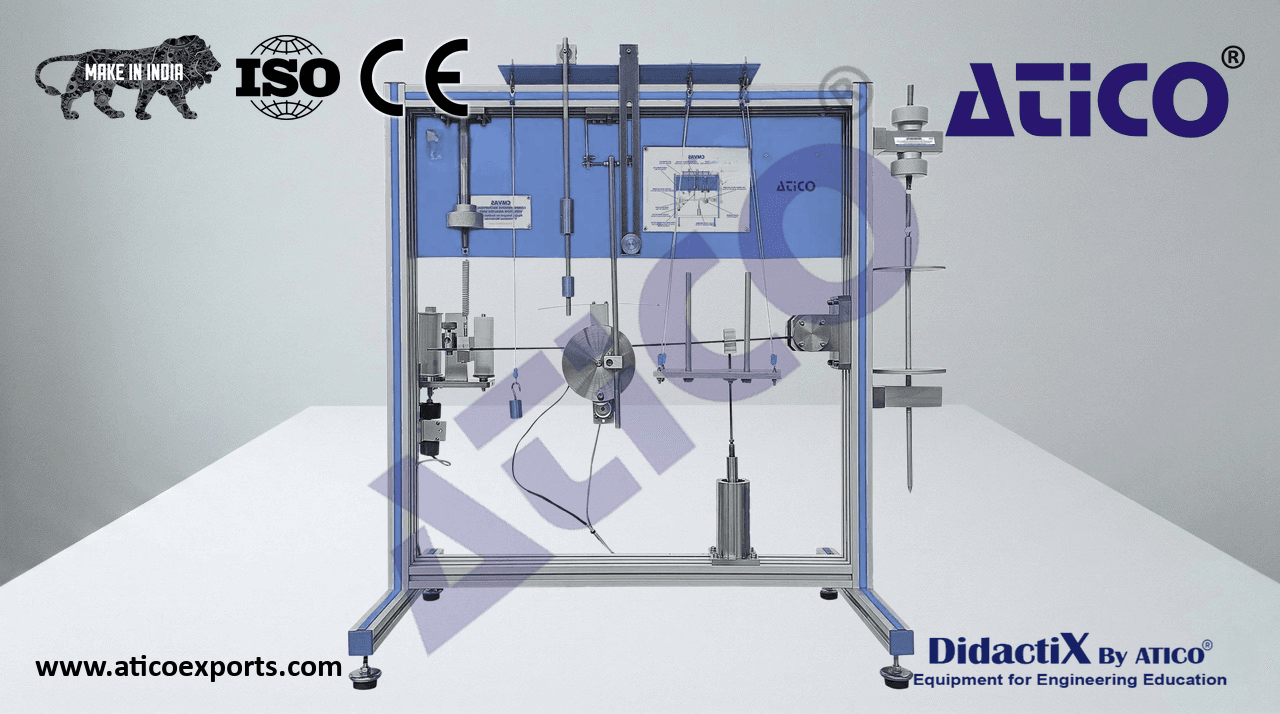
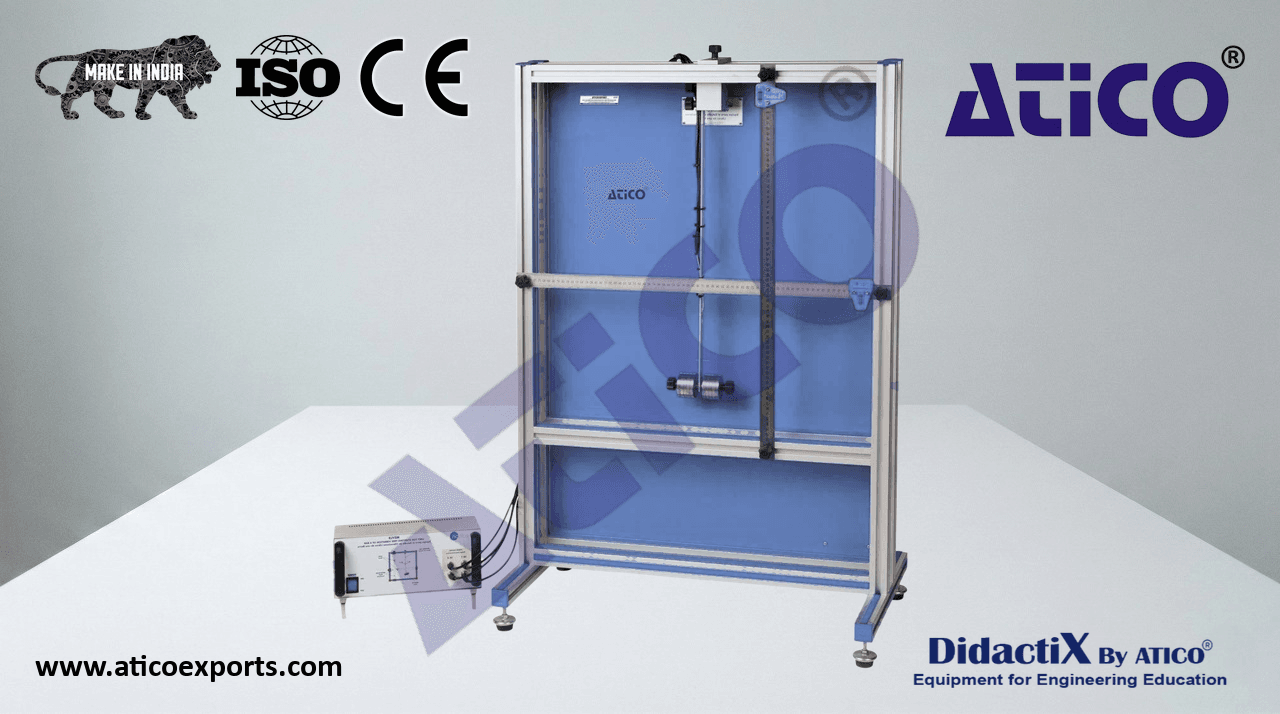
The main structure of the unit consists of a rigid frame made of aluminum profiles, with grooves along its longitudinal axes to allow the
movement of all the elements that make up the unit.
This unit features a flexible design that grants it the ability to perform different types of tests focused on vibration
analysis. It allows the study of oscillatory motion through pendulums such as the bifilar pendulum, string pendulum,
rod pendulum with adjustable center of mass, or through a flat steel pendulum with longitudinal grooves to couple
and move the selected weight. All these pendulums have easy coupling. The “ATENG 12121” has a thin plate on its upper
part where the different supports for each pendulum are located, allowing their oscillation without generating any
interaction with the other components.
Next, the unit presents a system to analyze oscillatory motion, but this time longitudinally through a mass-spring
system, located on one side of the unit. It simply consists of an axis suspended by a spring. The spring can be
easily changed by detaching it from the support at its top. It is important to emphasize that both supports of the
system can move vertically, as well as along the axis itself, by means of a threaded wheel, allowing us to adjust its
length. On the same axis, there are two weight holders on which the selected weights can be placed to perform
ATENG 12121 detail
the oscillation test.
- Three types of springs with different stiffnesses will be provided:
- Spring 1: 0.5 N/mm.
- Spring 2: 1 N/mm.
- Spring 3: 3 N/mm.
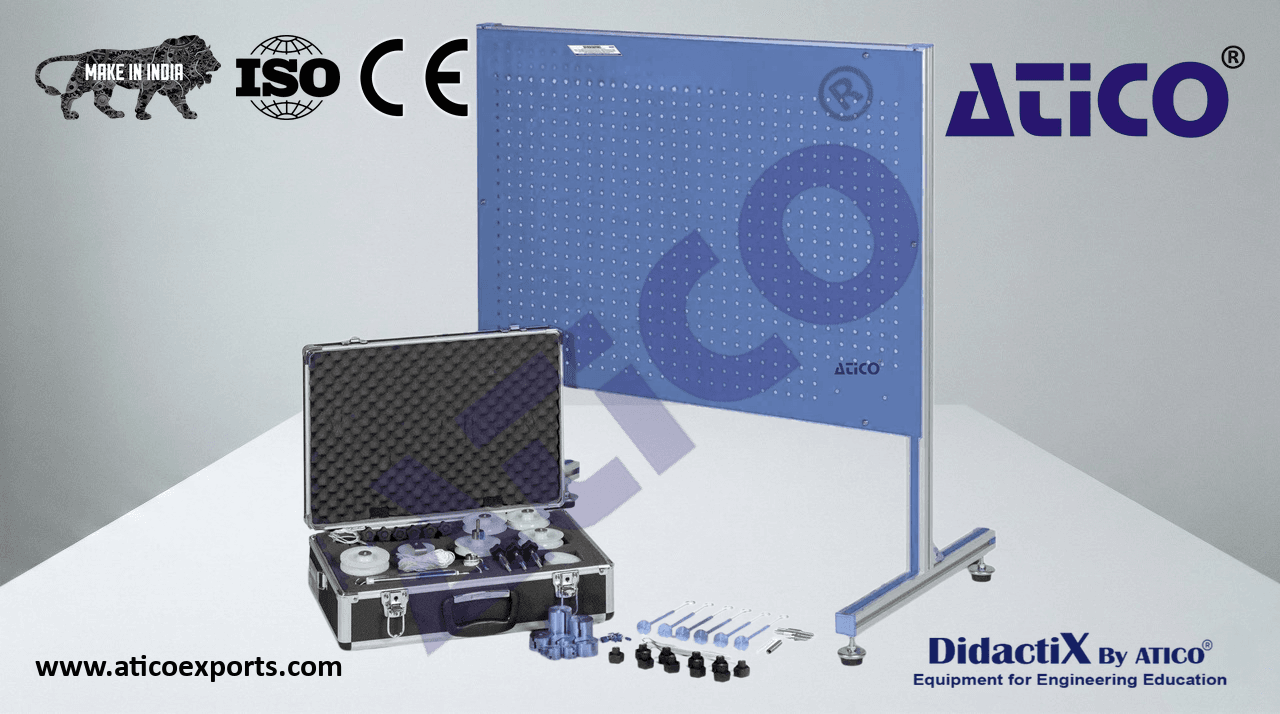
For both the analysis with pendulums and with the mass-spring system, a set of brass weights with a wide variety of weights will be provided,
- ranging from 75 grams to 2 kg weights.
For a more specific analysis of vibrations, the unit includes an oscillator system using a beam supported at one end by a vertically
displaceable support. On the beam, there is an excitatory system of electrical imbalance that can be moved along the beam, consisting of
a variable speed electric motor, a transmission system through a belt and two toothed pulleys, and most importantly, the unbalancer with
two discs located on either side of the beam, on which different brass weights can be fixed, generating an eccentricity in the rotation of
these discs and causing the beam to vibrate. This exciter is essential for generating forced vibrations. A series of specific weights for these
discs will also be provided.
Additionally, this system includes a beam support system at the free end through an interchangeable spring (the same ones mentioned
for the mass-spring system), which is also displaceable along the beam. The height of the beam can be adjusted both by moving the
support and by changing the action length of the spring. This possibility of adjustment generates a large number of options for generating
oscillations of greater or lesser amplitude.
On the other hand, this oscillator system has a damped vibration analysis system with an adjustable and displaceable oil damper,
anchored at the bottom of the structure, allowing for controlled damping (the necessary oil is provided), and also features a damping
system using leaf springs located in the electric exciter, on which specific weights are placed.
- For recording the oscillations the beam, the unit has two different methods:
The first is based on an electrical recording unit through a drum where paper is rolled up. A synchronous electric motor allows the drum
to rotate, and consequently, the paper to advance at a constant speed. This recorder can be moved vertically and also has a support
(located on the beam and also displaceable) to place the drawing tool needed to record the oscillation curves.
The second recording system is a polar disk placed on one of the imbalance discs of the exciter, where a polar diagram can be obtained
during oscillations. The drawing tool is suspended in the air by means of a support fixed to the upper part of the structure, which allows
it to be moved longitudinally.
Finally, the “ATENG 12121” is equipped with a ATENG 11722 module for the control of the electric motors of both the exciter and the electric recorder.
This module has an ON/OFF button, a power switch for the electric drum, a switch and a speed regulation wheel for the exciter motor. It
also has a display that reflects the speed of rotation.
Cables and accessories, for normal operation.