
Loading product…
Loading product…
Need Help?
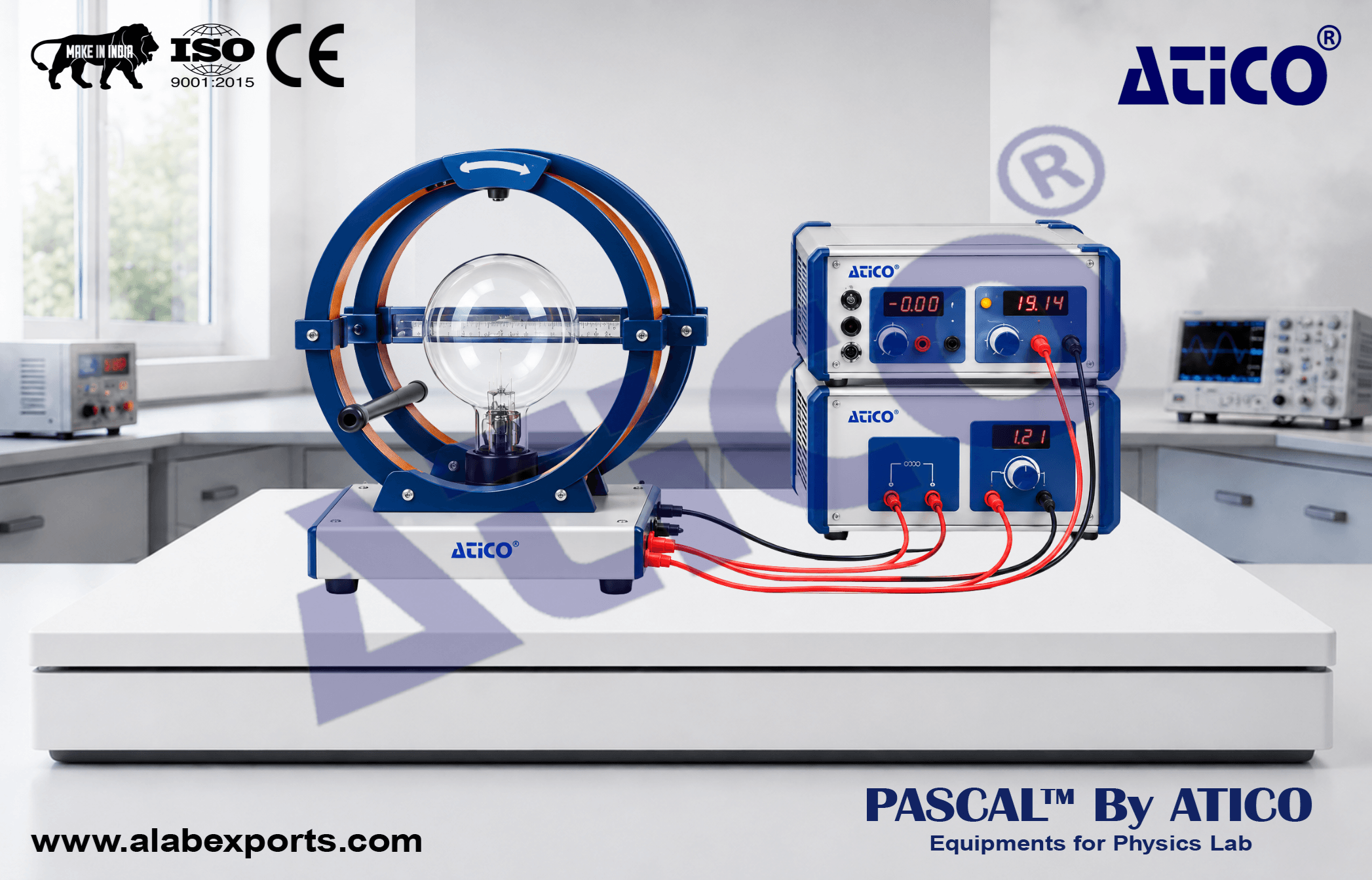
+91 98967 93832The Charge-to-Mass Ratio System is designed to reproduce the landmark experiment conducted by J. J. Thomson in 1897, which demonstrated that cathode rays consist of negatively charged particles known as electrons. The experiment provided the first measurement of the charge-to-mass ratio of the electron, one of the fundamental constants of the universe.
The apparatus allows students to accurately determine the charge-to-mass ratio of electrons and investigate their behaviour in magnetic and electric fields. The electron tube can be rotated through 90°, enabling students to study electron beam deflection under different magnetic field conditions. It also includes deflection plates for investigating the effect of an electric field on moving electrons.
The system consists of a large helium-filled electron tube mounted between a pair of Helmholtz coils. An electron gun inside the tube produces a focused electron beam. A measured current is supplied to the Helmholtz coils to determine the magnetic field strength, while an accelerating voltage is applied to the electron gun. The magnetic field deflects the electron beam into a circular path, and its radius is measured using an illuminated millimeter scale. These measurements are used to calculate the charge-to-mass ratio of the electron.
Manufactured by Atico Export under expert engineering guidance for reliable physics experiments, scientific learning and practical laboratory applications.
Helmholtz Coil Radius :
Number of Turns :
Maximum Current :
Filament Voltage :
Acceleration Voltage :
Tube Diameter :
What's Included :