
Loading product…
Loading product…
Need Help?
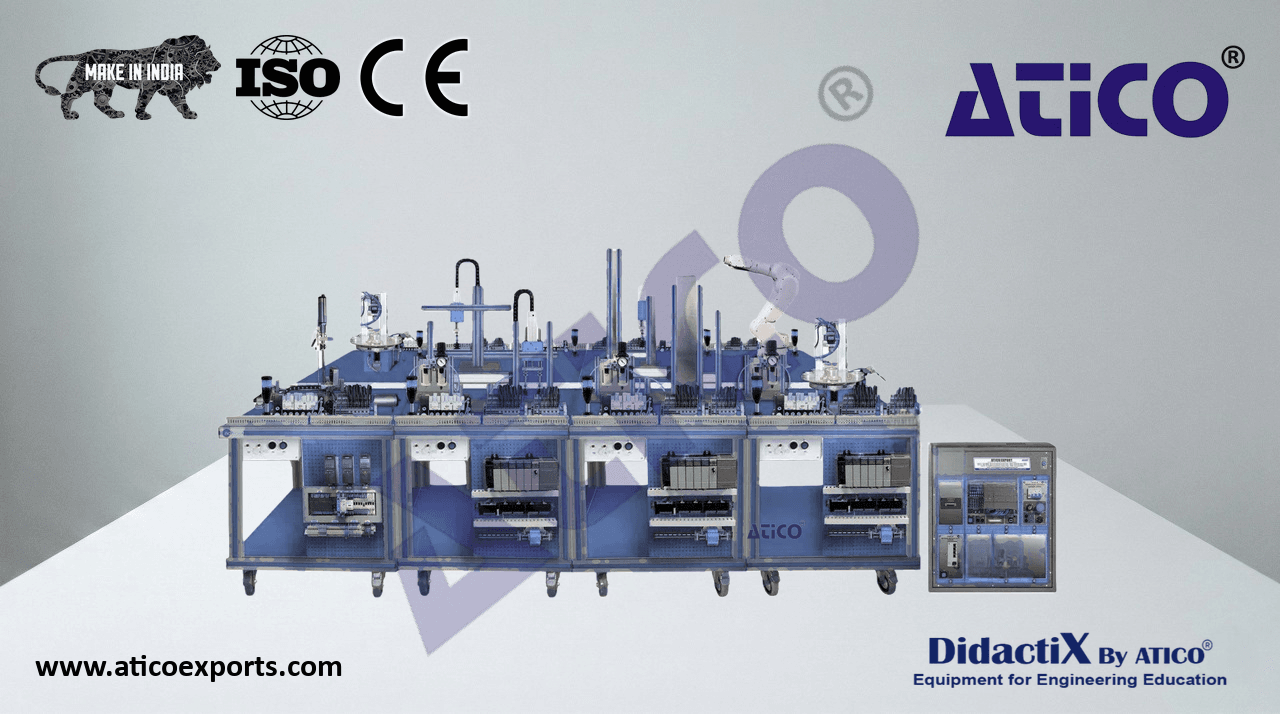
+91 98967 93832The Flexible Manufacturing System for Transport, Assembly, Pressing, Selection, Screwing, and Storage, enables the study and practice of an automated production cycle consisting of 9 distinct workstations.
Specifications
Specifications
Specifications
Specifications
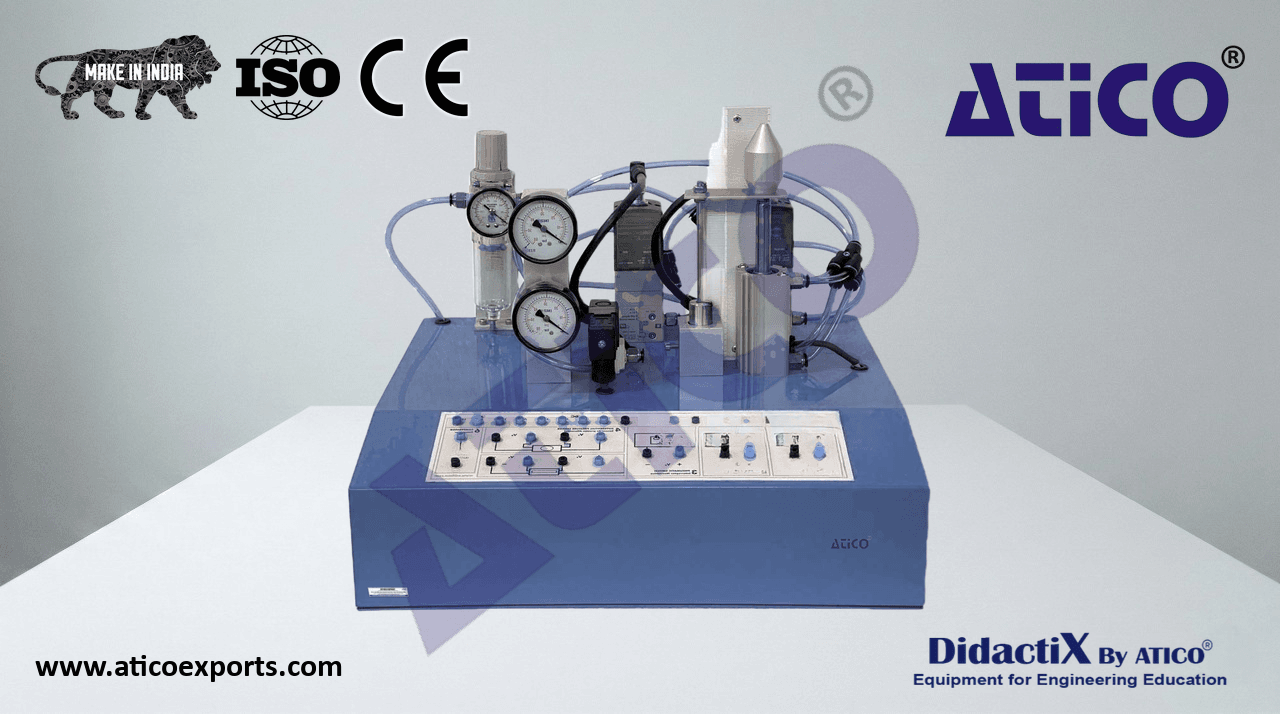
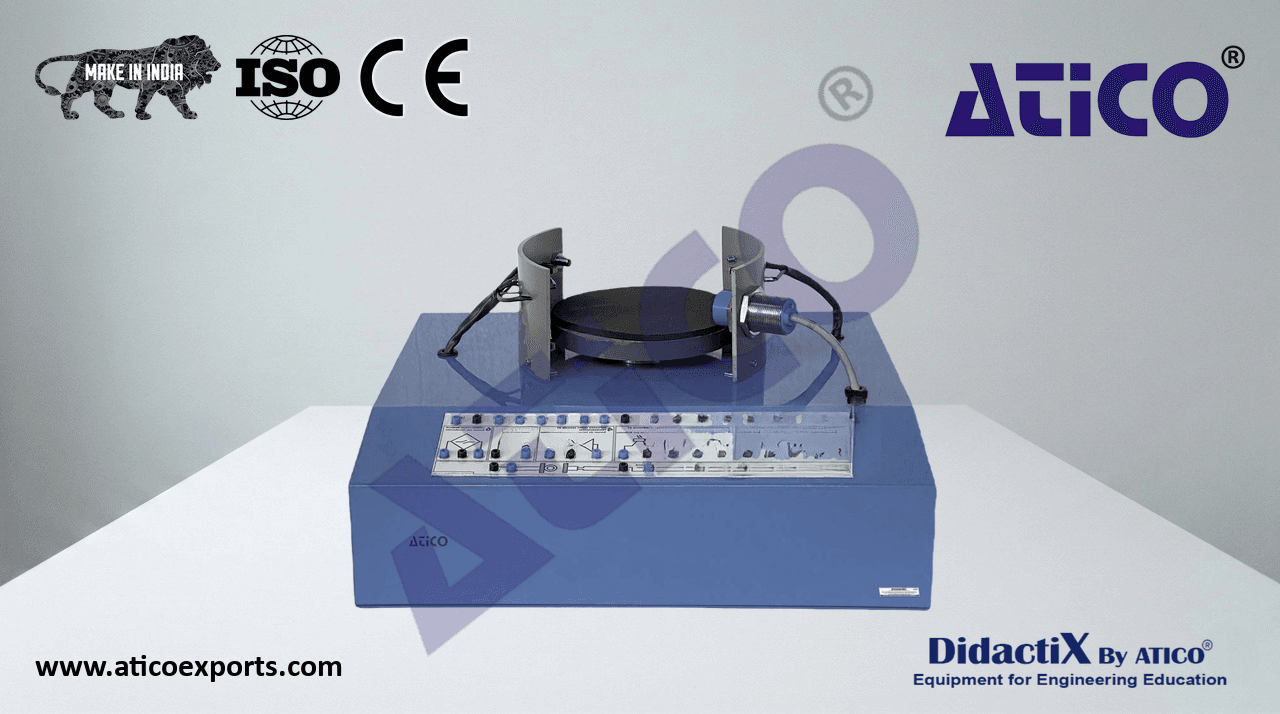
ATENG 12565. Rotary Table Workstation: Feeding, Quality Control and Assembly
(dimensional study).
The “ATENG 12565” is an automatic rotary table with a feeder, quality control and
mounting system integrated into it. The “ATENG 12565” has a vertical storage, the
system provides pieces one by one to the rotary table, then, a quality control system
checks that the piece has the correct dimensions and material. Finally, if the part
is appropriated, is mounted with lid. If the part has not the correct dimensions or
material is discarded by the rotary table.
The “ATENG 12565” workstation is designed as a modular system to facilitate the
understanding.
ATENG 12565
The main components are:
The PLC: is composed by the CPU limit and all extra modules needed to perform a corrent
working of the workstation and all the extra modules needed to perform a correct working of the
workstation.
The Control Panel: with start/stop button, emergency pushbutton, reset button, light indicators
to show current state of the process, etc.
The Pneumatic Circuit: contains the required solenoid valves, the pressure components, the
filters and regulators to assure the appropriate working of the unit.
The Workstation: it is composed by real industrial components used by the rotary table systems
such as reed sensors, presence sensors, DC motor, inductive sensors, rotary table with 8 positions,
etc.
The pneumatic circuit and the workstation are distributed in the following sections:
Air Treatment System: it contains a filter-regulator block with a water trap and shut-off valve to
control the air pressure input to the unit. Includes a dual-scale pressure gauge to visualize the
pressure level supplied to the unit.
Parts Feeding Section: it contains vertical storage to store the parts. The parts are supplied to the
unit one by one through a double-acting cylinder. Each of the two inputs of the double-acting
cylinder has an adjustable airflow valve with a bypass to regulate the cylinder speed.
Parts Displacement Section: it is a rotating table designed to move the input parts to the verification
and classification areas. The table is powered by a DC motor that includes an encoder and brake.
Parts Verification Section: it is designed to detect if the parts supplied to the unit have a hole in
the center and if the material of the parts is metal or PVC. The parts verification module checks
these features for further classification of unwanted parts. These verifications are carried out using
height and inductive sensors.
Parts Sorting Section: it is designed to classify the parts; if the part does not have the desired
characteristic, the classification telescopic suction cups are activated, and the part is stored in the
unwanted parts classification area; and if the part has the desired characteristic, the gripper or
rotary actuator for classification is activated, and the part is stored in the good parts area.
Signaling Tower: it contains green, yellow, and red LED lights to indicate the system’s status.
Solenoid Valve Block: it is a distributor block of pneumatic valves with twelve solenoid valves, two
of which function as 3/2 monostable solenoid valves, six as 5/2 monostable solenoid valves, and
four as 5/2 bistable solenoid valves.
Electrical Terminal Block: it contains all accessible and identified unit signals for manual unit
checking. The electrical terminal block has color-coded terminals to help the user identify the type
of each signal, and it also contains the name of each signal.
9
Specifications:
Table with four wheels with brakes mounted with aluminum profiles.
Programming software PLC:
Programming software developed according to the norm IEC 61131-3.
Compatible with Windows operating systems.
5 programming languages:
Ladder diagram (LD).
Structured text (ST).
Instructions list (IL).
Sequential function chart (SFC).
Function block diagram (FBD).
Programming, service and remote diagnostics.
Minimun program size.
Powerful debugging and monitoring tools.
Support for user-created functions and function blocks.
Save project files in plc.
Quick start tutorial example included.
Electrical Panel:
Differential magneto-thermal switch.
Power supply of 24 VDC.
Control Panel:
Mushroom head emergency stop push button switch.
Start and stop pushbuttons.
Switch for manual or automatic operation.
Light indicator.
Led stack light.
Fault Injection Key Box Module:
Red key box module with 20 switches inside.
2 DB37 connectors.
Each fault is generated via toggle switches.
Electrical Components:
Round table with 8 positions.
DC motor.
1 dryve D8, step/direction stepper motor control system.
Pneumatic Circuit:
Air treatment unit:
Filter-regulator with water trap.
Manometer with double scale indicator.
Shut-off valve.
24 flow control valves.
8 single acting pneumatic actuators.
2 pneumatic solenoid valves 3/2 monostable.
6 pneumatic solenoid valves 5/2 monostable.
4 double acting pneumatic actuator.
4 pneumatic solenoid valves 5/2 bistable.
Individually identified tubes and push in fittings
Vacuum Circuit:
2 Telescopic suction cup.
2 Venturi effect vacuum ejector.
2 pneumatic solenoid valves 3/2 monostable.
2 pressure relief valve.
Sensors:
16 reed effect limit switches.
2 capacitive sensors.
Inductive sensor.
Height sensor.
Encoder of the rotating table.
10
ATENG 12566. Rotary Table Workstation: Feeding, Quality Control, and Assembly (material and
color study).
Its function is to supply a fourth piece and to assemble it to the base piece already supplied by the
previous modules, being this piece black or white and made of metal or plastic. The “ATENG 12566”
includes a vertical storage for the pieces that will be supplied one by one to the rotating table system
by a dispensing system. Once the piece is in the rotating table, it rotates and a different operation is
performed on it every time it rotates. In the first position of the table the type of material of the piece is
detected (plastic or metal). In the second position the presence of a piece is detected by a capacitive
sensor. In the third position the color of the piece is detected by an optical sensor. In the fourth position
the height of the piece is checked by a linear sensor and a cylindrical pneumatic actuator. In the fifth
position, the wrong pieces are discarded by a manipulator that carries them to the rejection area. The
last position is only reached by the pieces that fulfill the specifications of the system. In this last stage,
a rotating arm takes the piece and assembles it inside the base piece supplied in previous stages. This
operation will be performed directly in the Linear Transport Workstation “ATENG 12572” to continue with
the manufacturing process.
Specifications:
Mounted with aluminum profiles.
20 pieces:
2 different heights.
2 different materials:
Aluminum.
PVC.
3 different colors:
Silver, white and black.
Vertical storage for pieces.
Table with four wheels with brake.
Rotating table:
Round table with 8 positions.
DC motor.
Control panel:
Emergency pushbutton.
Start/Stop pushbuttons.
Manual/automatic switch.
Light indicators for signaling.
Pneumatic circuit:
Air treatment unit:
Filter-regulator with water trap.
Manometer with double scale indicator.
Shut-off valve.
Cylindrical simple effect pneumatic actuator:
Material: stainless steel.
Normally retracted rod.
Diameter: 20 mm.
Stroke of 100 mm.
Cylindrical pneumatic double effect actuator:
Material: stainless steel.
Diameter: 20 mm.
Stroke of 50 mm.
Profile pneumatic double effect actuator:
Material: stainless steel and aluminum.
Stroke of 100 mm.
2 pneumatic double effect external grip clamps.
2 rotary pneumatic actuators with 50 mm rod.
6 pneumatic NC monoestable 3/2 solenoid valves.
3 pneumatic bistable 5/2 solenoid valves.
Individually identified tubes and push in fittings.
Vacuum circuit:
3 flat suction pads made of NBR rubber.
Venturi effect vacuum ejector.
Vacuum switch.
Pneumatic NC monostable 3/2 solenoid valve.
Sensors:
Inductive effect sensor to determine the type of material of the piece (metal or plastic).
Capacitive effect sensor to determine the presence of the piece.
Optical sensor to determine the color of the piece.
Linear potentiometer of 50 mm stroke to check the height of the piece.
13 reed effect limit switches to check the position of the pneumatic actuators.
Encoder to detect the position of the rotating table.
Fault generation module:
Attached to the frame of the unit.
Generates faults in the operation of different elements of the unit using switches.
11
Specifications
Specifications
Specifications
Specifications
Specifications
Single-phase motor with 340 W.
Low noise level with 40 dB of maximum.
Specifications
It is recommended to use the corresponding kits of each brand depending on the PLC selected (Panasonic,
Specifications
Specifications
Specifications
Specifications