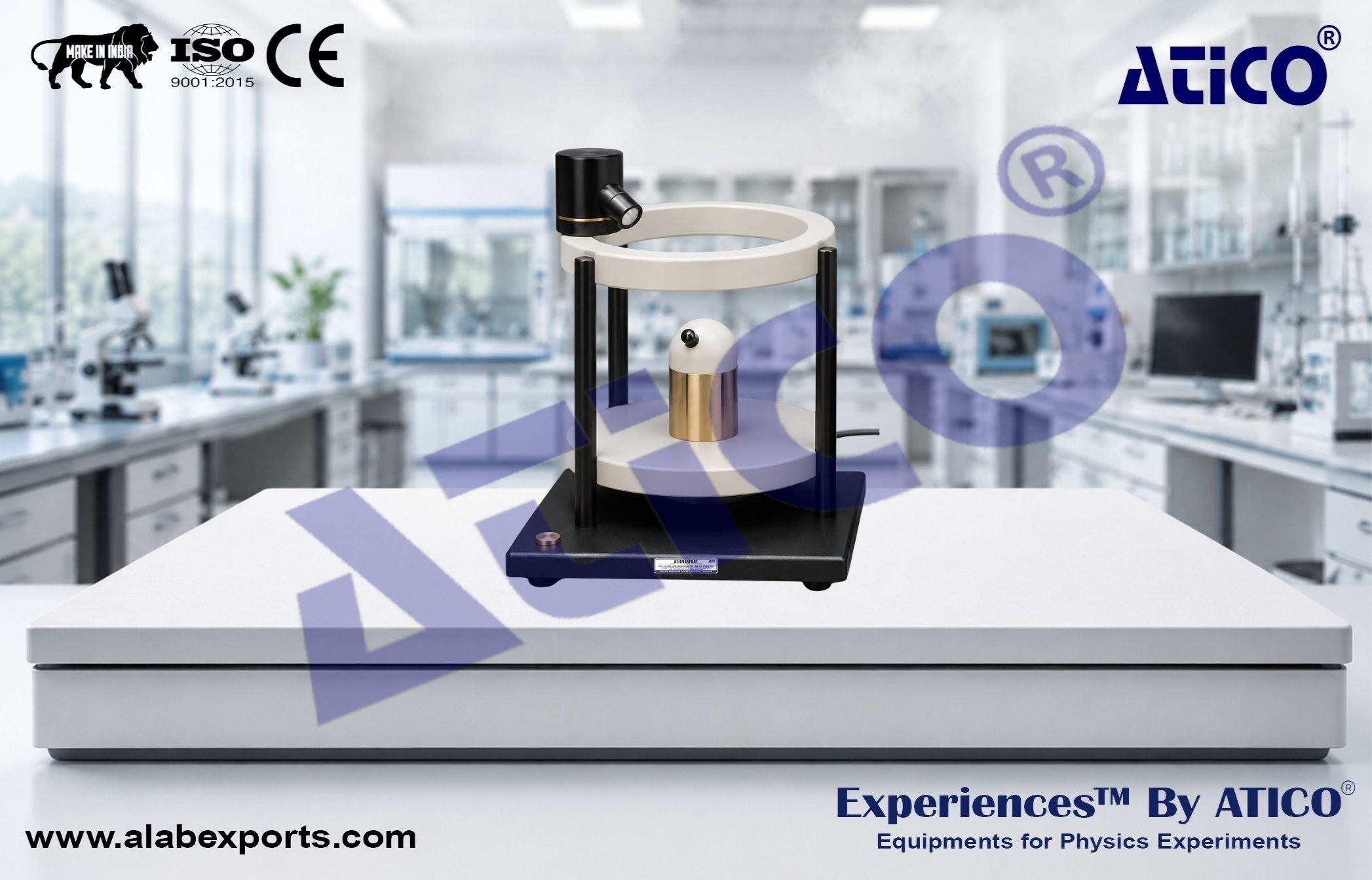
This Magnetic Torque experiment system is designed to investigate the interaction between magnetic dipoles and external magnetic fields through quantitative studies of magnetic torque, magnetic force, simple harmonic motion, and precession. Using a precision magnetic dipole mounted inside a low-friction rotating sphere and a Helmholtz coil system, students can determine magnetic moment by multiple experimental methods and explore the fundamental principles of magnetic resonance through a classical analog of Nuclear Magnetic Resonance (NMR). The system also includes a magnetic force balance for field-gradient experiments, making it ideal for introductory, intermediate, and advanced physics laboratories. Manufactured by Atico Export India.
Experiments :
- Measure Magnetic Torque Produced by a Uniform Magnetic Field.
- Determine the Magnetic Dipole Moment Using Magnetic Torque and Gravitational Torque Balance.
- Study the Relationship Between Magnetic Torque and Magnetic Field Strength.
- Investigate Simple Harmonic Oscillation of a Magnetic Dipole in a Uniform Magnetic Field.
- Determine the Magnetic Moment from Oscillation Period Measurements.
- Study the Precessional Motion of a Rotating Magnetic Dipole.
- Measure the Relationship Between Precession Frequency and Magnetic Field Strength.
- Determine the Magnetic Dipole Moment from Precession Measurements.
- Demonstrate That No Net Force Acts on a Magnetic Dipole in a Uniform Magnetic Field.
- Observe Magnetic Force Generated by a Magnetic Field Gradient.
- Measure Magnetic Force and Calculate the Magnetic Dipole Moment.
- Compare Torque and Force Effects in Uniform and Non-Uniform Magnetic Fields.
- Demonstrate the Principles of Magnetic Resonance Using a Classical Mechanical Model.
- Observe and Demonstrate the Classical Analog of Pulsed NMR Spin Flip.
- Estimate Spin Nutation Time Under a Rotating Magnetic Field.
- Investigate the Relationship Between Angular Momentum, Magnetic Moment, and Larmor Precession.