

Loading product…
Loading product…
Need Help?
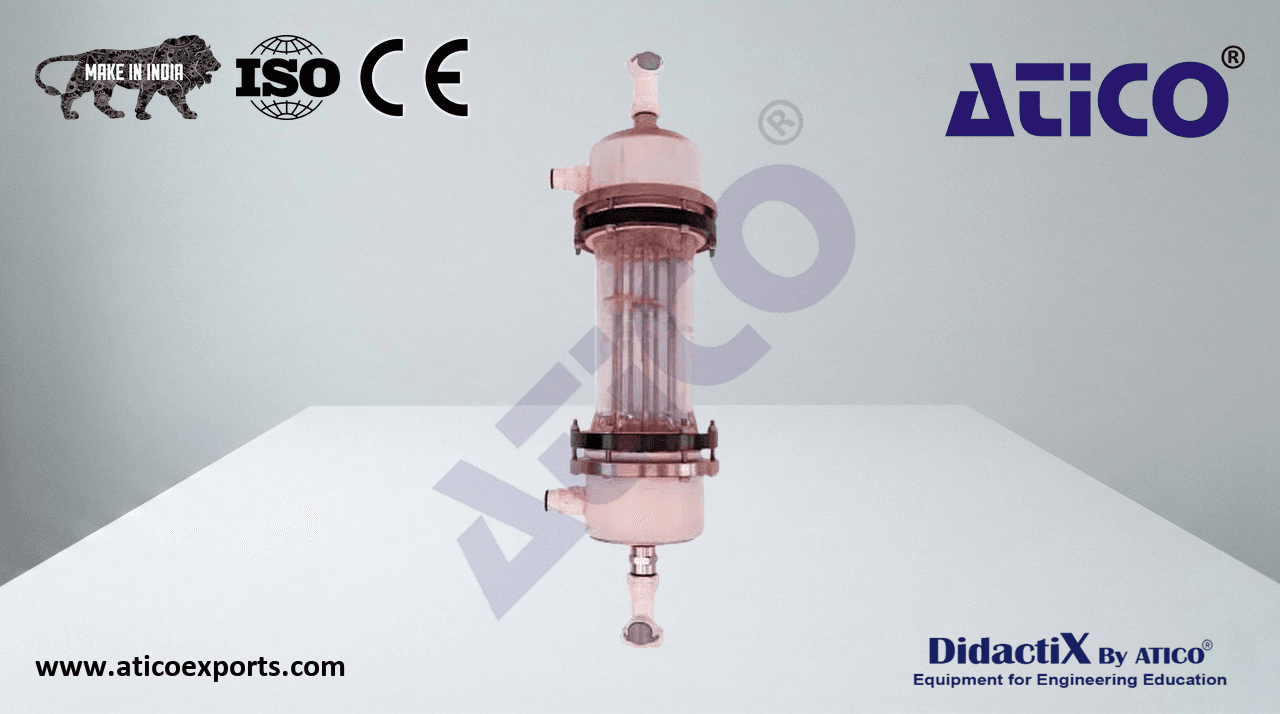
+91 98967 93832A simple model that demonstrates the basic principles of heat transfer, designed for use with the Heat Exchanger Service Unit. The miniature heat exchanger consists of a clear glass shell with end plates through which pass a bundle of seven equally spaced stainless steel tubes. 'O' ring seals in the end plates allow the stainless steel tubes to be removed for cleaning if necessary. Learn about SHELL and TUBE HEAT EXCHANGER manufacturers for optimal educational outcomes.. Coupled to the end plates are end caps that allow hot water to pass through all seven tubes and then re-combine to return to the heater/circulator in a closed loop. Cold water from the mains supply passes through the clear glass outer shell and heat is transferred from the hot stream. Learn about SHELL and TUBE HEAT EXCHANGER heat-transfer India for optimal educational outcomes.. Two baffles are located in the shell to promote turbulence and increase the cold fluid velocity. In normal operation, hot water passes into the end cap via a stainless steel braided hose and self-sealing coupling, with its entry temperature measured by a thermocouple. Learn about Turbulence SHELL and TUBE HEAT EXCHANGER for optimal educational outcomes.. It then flows through the seven heat exchanger tubes to the opposite end cap. The cold water is fed into and out of the heat exchanger via plastic reinforced hoses with self-sealing couplings. Learn about SHELL and TUBE HEAT EXCHANGER for educational labs for optimal educational outcomes.. Thermocouples measure the cold water inlet and exit temperatures.


