

Loading product…
Loading product…
Need Help?
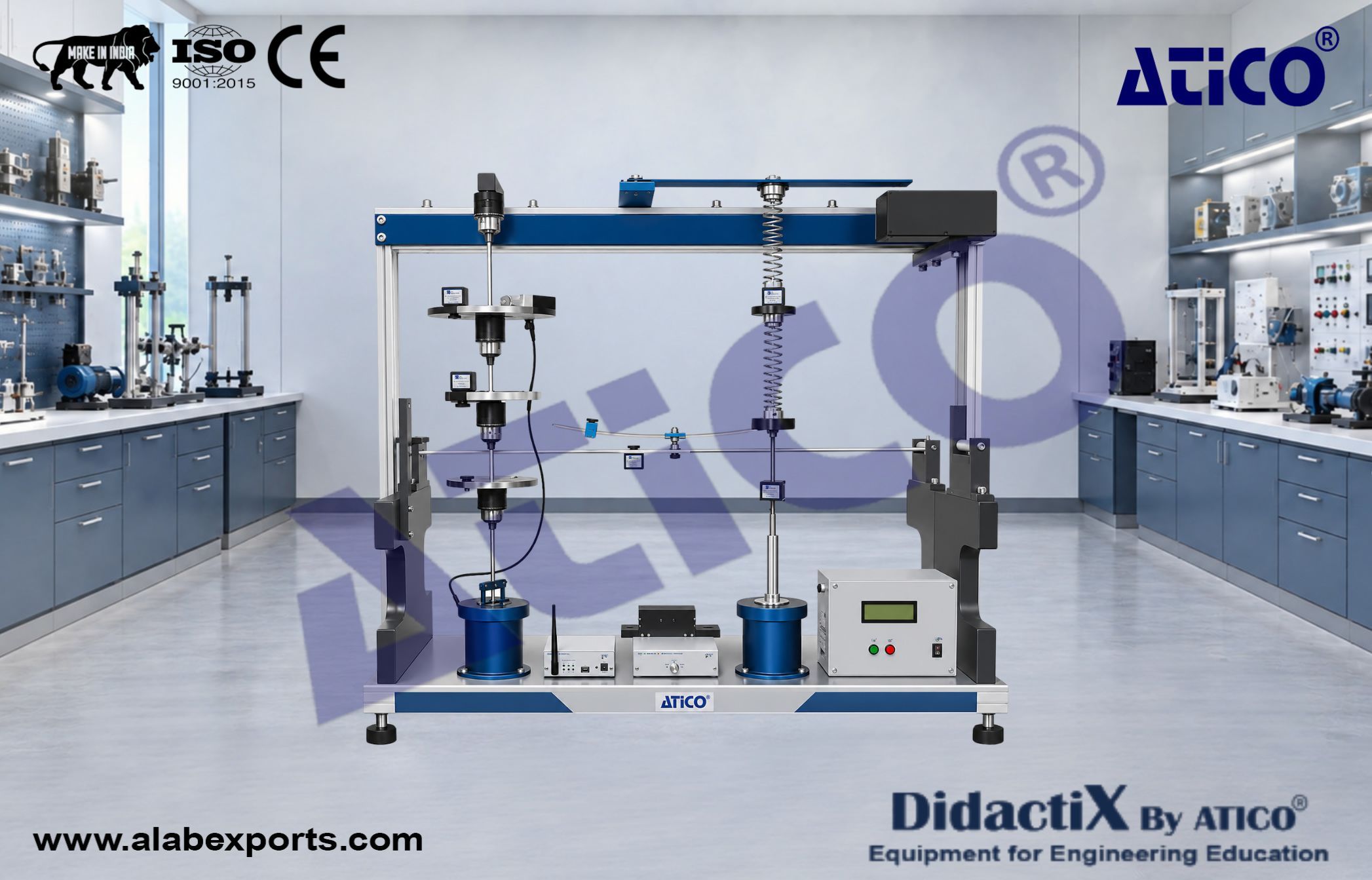
+91 98967 93832The Vibration Fundamentals Training System is a fully integrated educational package designed to teach the fundamental principles of mechanical vibration and engineering mechanics. It provides a comprehensive hands-on experimental device along with an instrumentation package, including wireless sensors, for conducting laboratory exercises and enhancing students' understanding of vibration theory.
The system connects classical vibration theory with practical experimentation by allowing students to validate theoretical predictions and observe the effects of parameter changes on system responses. Students can perform virtual experiments using vibration simulation software and verify the results through actual experiments, helping them understand complex vibration principles. Wireless sensors enable free vibration experiments with minimal additional damping caused by sensor cables. The system is suitable for teaching mechanical vibration courses at undergraduate and postgraduate levels.
With the increasing use of high-speed manufacturing and automation, vibration theory has become essential for machinery design, maintenance, condition monitoring and fault diagnosis. This training system provides laboratory demonstrations and hands-on experiments to help students understand vibration concepts through practical learning.
Manufactured by Atico Export under expert engineering guidance for reliable mechanical engineering education, laboratory training and experimental research.
Controlled experiments expedite learning :
The Vibration Fundamentals Training System is designed for teaching the fundamental principles of mechanical vibration and can be easily integrated into standard vibration courses. It provides a comprehensive experimental device, instrumentation package and experimental program with course curriculum for conducting laboratory exercises.
The benchtop apparatus features a spacious modular design with versatility, operational simplicity and robust construction. Each component is machined to high tolerances to ensure controlled experimental operation. The instrumentation package includes wireless accelerometers and transducers, a precision servomotor for excitation, tachometer, four-channel simultaneously sampled data acquisition hardware, signal conditioners and time-domain and frequency-domain analysis software.
The system also includes vibration theory simulation software and a structured experimental program for free and forced vibration experiments, ranging from single-degree-of-freedom spring-mass systems to continuous beams with different boundary conditions.
Students can perform both hands-on and virtual experiments to improve their understanding. The system supports free and forced vibration experiments with and without damping. Its basic frame consists of two identical test stations mounted on a portable structure. It features interchangeable restraint fixtures, optional force transducers for measuring support reactions, sensors for measuring deflection and acceleration, and a variable-frequency rotary shaker for forced excitation.
The wireless sensor technology enables low-damping vibration experiments and helps students verify theoretical principles through practical measurements.
Benefits :


