

Essential Engineering Laboratory Equipment for Modern Education
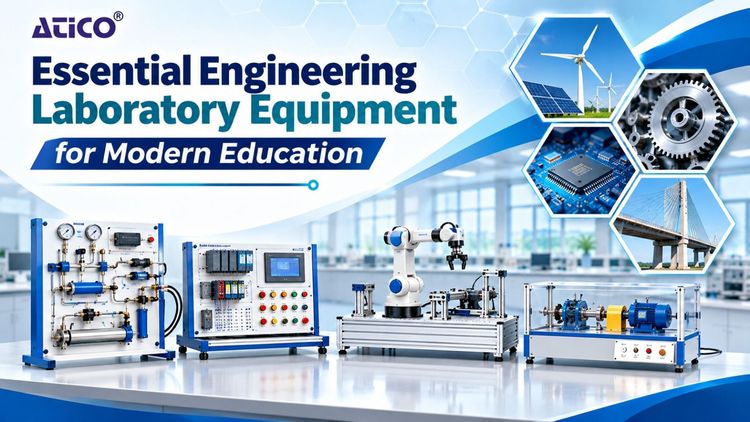
Discover the essential engineering laboratory equipment required for modern technical education. Explore different types of engineering lab equipment, their applications and how to select the right instruments for colleges and universities.
In 2026, the quality of modern engineering education depends on its laboratory infrastructure. Classroom learning helps with theoretical knowledge, but engineering laboratory equipment is used to convert that theory based knowledge into practical expertise. Well equipped and high tech facilities are the backbone of modern engineering labs.
Today, universities and technical institutions must go beyond basic experimentation. Modern education today, needs advanced lab equipment that supports research, innovation, and real world problem solving. Therefore, it is important to ensure that the laboratory in your institution is equipped with high quality lab instruments which also satisfies national and international quality standards.
Institutions that collaborate with a reliable Technical Educational Equipment Manufacturer can ensure compliance, safety, durability, and long term scalability. As competition in higher education intensifies, investing in modern, technology driven labs is no longer optional: it is essential for producing industry ready engineers equipped to meet the demands of tomorrow’s workforce.
What is Engineering Laboratory Equipment?
Engineering laboratory equipment are the set of special instruments, machines, tools, and analytical systems that are used in educational institutions, research centres, industrial labs, and healthcare facilities to conduct experiments, testing, design validation, and innovation.
In modern engineering labs, these engineering lab equipment are used in multiple subjects such as mechanical, electrical, civil, electronics, biotechnology, environmental engineering, and applied sciences. In modern engineering education, these lab equipment plays an important role by helping students and learners gain hands on learning experience. These also help in increasing research accuracy and helps with industry ready skill development.
A well planned laboratory setup for colleges includes testing devices, analytical instruments, safety systems, calibration tools, and digital data acquisition systems. Institutions investing in high quality equipment from a trusted Technical Educational Equipment Manufacturer ensure accreditation compliance, research capability, and long term infrastructure sustainability.
Why Modern Engineering Laboratories Are Essential for Institutions
The role of modern engineering labs has evolved significantly in recent times. Therefore, colleges and universities must invest in high quality laboratory equipment for Modern Engineering Education. The benefits of these advanced lab instruments are discussed below:
Industry Ready Graduates
Today, employers want graduates to be job ready from day one. They must have all the required skill sets. Practical exposure to real world tools, testing systems, automation platforms, and simulation software helps students develop applied technical skills.
Modern engineering labs equipped with industry standard machines and Aggregate Testing Lab Equipment help students develop practical civil engineering knowledge. Such systems are commonly supplied by an experienced Civil Engineering Lab Equipment Manufacturer and play a critical role in infrastructure and construction education.
Modern engineering labs equipped with industry standard machines, instruments, and digital systems help students:
- Perform real time data analysis
- Troubleshoot complex systems
- Work with automation and Industry 4.0 technologies
- Develop hands on design and manufacturing experience
A well planned engineering lab setup erases the gap between academic curriculum and industrial requirements. It significantly improves graduate competency.
Accreditation Requirements
Regulatory and accreditation bodies evaluate laboratory infrastructure when checking institutional quality. Organisations such as NAAC, ABET, and AICTE require:
- Updated laboratory equipment
- Proper documentation and calibration standards
- Must satisfy safety rules and have operational readiness
- Student to equipment ratio alignment
For civil engineering departments, access to Aggregate Testing Lab Equipment is essential for teaching material strength, road construction, and infrastructure testing. Institutions that procure equipment from a certified Civil Engineering Lab Equipment Manufacturer are better prepared to satisfy accreditation requirements.
Institutions that maintain modern engineering labs in accordance with accreditation guidelines secure approvals more easily. They also strengthen their academic credibility. You must get your lab equipment from experienced engineering lab equipment suppliers. It ensures compliance with national and international standards.
Research & Innovation Capabilities
Research driven institutions depend mainly on advanced laboratory infrastructure. Whether it’s prototyping, materials testing, robotics development, or renewable energy experimentation, high quality engineering laboratory equipment enables innovation at every level.
Civil engineering research laboratories especially rely on Aggregate Testing Lab Equipment for studying road materials, soil stability, and construction quality. These specialised instruments are usually supplied by a reliable Civil Engineering Lab Equipment Manufacturer.
Advanced labs encourage:
- Faculty led research projects
- Industry sponsored R&D initiatives
- Patent development and publications
- Startup incubation within campuses
Access to cutting edge tools and research grade instruments transforms colleges into innovation hubs rather than just teaching centers.
Placement and Employability Outcomes
Placement performance is one of the strongest indicators of institutional success. Companies prefer to employ from colleges that provide strong practical exposure and industry relevant training.
Modern laboratories supplied by a leading Technical Educational Equipments Manufacturer improve employability by:
- Offering hands on certification programs
- Supporting live industrial simulations
- Enabling skill based workshops
- Preparing students for technical interviews and practical assessments
Institutions investing in advanced lab equipment get benefits in admissions and research funding. They also attract better industry partnerships, stronger placement records, and higher student enrollment rates.
What Type of Engineering Laboratory Equipment Exists?
Engineering laboratory equipment can be broadly categorised based on function and discipline. Below are the major types of Laboratory Equipment used in modern engineering labs:
- Measurement Instruments
- Testing Machines
- Laboratory Glassware
- Sensors and Transducers
- Computer and Software
- Fluid Mechanics Equipment
- Material Testing Equipment
- Electrical & Electronics Equipment
- Biotechnology & Life Science Equipment
- Laboratory Heating & Cooling Systems
- Aggregate Testing Lab Equipment
Modern engineering laboratory equipment manufacturers design these systems to meet academic, research, and industrial standards. The exact equipment required for your laboratory depends on multiple factors like subjects taught, experiments performed, and other laboratory requirements.
Essential Laboratory Equipment for Different Institutions
Different engineering laboratories require different types of equipment. For example, civil engineering laboratory will need equipment for material testing, soil testing, rock testing, etc, whereas, an electrical engineering laboratory requires measuring instruments, electrical machines and circuit training systems. You must understand your institution and its requirements in detail to make the right choice of lab equipment.
Civil Engineering Laboratory Equipment
Civil engineering laboratories help students understand the properties, strength and performance of construction materials and soil. Some essential civil engineering laboratory equipment includes:
Concrete Testing Equipment
Concrete is one of the most widely used construction materials. Testing the strength and workability of concrete material helps students understand how it performs under different loading and environmental conditions.
Common equipment includes:
- Compression Testing Machine
- Concrete Slump Test Apparatus
- Concrete Cube Moulds
- Concrete Flexure Testing Machine
- Vee-Bee Consistometer
- Concrete Permeability Apparatus
These instruments are used to study compressive strength, workability, flexural behaviour and other important properties of concrete.
Soil Testing Laboratory Equipment
Soil investigation is an important part of civil engineering because soil characteristics directly influence the design and stability of foundations and other structures. Commonly used soil testing instruments include:
- Direct Shear Apparatus
- Triaxial Shear Test Apparatus
- California Bearing Ratio (CBR) Testing Machine
- Liquid Limit Apparatus
- Plastic Limit Testing Equipment
- Sieve Shaker
- Permeability Apparatus
- Standard and Modified Proctor Compaction Apparatus
These instruments help students understand soil classification, compaction characteristics, permeability and shear strength.
Aggregate Testing Lab Equipment
Aggregates are important components of concrete and road construction materials. Their physical and mechanical properties influence the strength, durability and performance of construction structures. Common aggregate testing laboratory equipment includes:
- Aggregate Impact Testing Machine
- Los Angeles Abrasion Testing Machine
- Aggregate Crushing Value Apparatus
- Flakiness and Elongation Index Apparatus
- Sieve Shaker
- Specific Gravity and Water Absorption Testing Equipment
These instruments help students examine aggregate strength, grading, shape and resistance to wear and impact.
Building Material Testing Equipment
Apart from concrete, soil and aggregates, civil engineering students also study materials such as cement, bricks and bitumen.
Equipment such as cement testing apparatus, brick testing machines, bitumen testing instruments and aggregate testing systems helps students examine the quality and performance of different construction materials.
A properly equipped civil engineering laboratory provides students with practical knowledge of testing procedures followed in construction projects and material quality assessment.
Mechanical Engineering Laboratory Equipment
Mechanical engineering laboratories focus on the principles of mechanics, thermodynamics, manufacturing, machine design and fluid systems. Students use specialised equipment to understand how machines operate, how energy is transferred and how different mechanical components perform under working conditions.
Some important mechanical engineering laboratory equipment includes:
Thermal Engineering Laboratory Equipment
Thermal engineering deals with heat, temperature, energy conversion and the performance of thermal systems. Common laboratory instruments include:
- Heat Transfer Apparatus
- Refrigeration Test Rig
- Air Conditioning Test Rig
- Steam Boiler Demonstration Unit
- Petrol Engine Test Rig
- Diesel Engine Test Rig
- Bomb Calorimeter
These instruments help students study heat transfer mechanisms, engine performance, refrigeration cycles and energy efficiency.
Fluid Mechanics Laboratory Equipment
Fluid mechanics is concerned with the behaviour of liquids and gases at rest and in motion. It has applications in hydraulic systems, water supply networks, pumps and industrial fluid transportation.
Essential equipment includes:
- Bernoulli's Theorem Apparatus
- Venturimeter and Orificemeter
- Reynolds Apparatus
- Pipe Friction Apparatus
- Centrifugal Pump Test Rig
- Hydraulic Bench
- Impact of Jet Apparatus
These instruments allow students to examine fluid flow, pressure variations, energy losses and hydraulic performance.
Strength of Materials Laboratory Equipment
This laboratory helps students understand the mechanical properties of different materials and how they respond to external forces. Common equipment under this section of curriculum includes:
- Universal Testing Machine
- Torsion Testing Machine
- Impact Testing Machine
- Spring Testing Apparatus
- Hardness Testing Machine
- Deflection of Beam Apparatus
Through practical experiments, students learn about tensile strength, compression, torsion, hardness and material deformation.
Manufacturing and Workshop Equipment
Practical manufacturing knowledge is another important part of mechanical engineering education.
Equipment such as lathe machines, drilling machines, milling machines, grinding machines and welding equipment helps students understand machining processes, fabrication techniques and workshop operations.
Electrical Engineering Laboratory Equipment
Electrical engineering laboratories help students understand electrical circuits, power systems, electrical machines and measurement techniques.
These laboratories provide practical exposure to electrical components and systems used in residential, commercial and industrial applications.
Some essential electrical engineering laboratory equipment includes:
- AC and DC Power Supply
- Digital Multimeter
- Digital Storage Oscilloscope
- Function Generator
- Single-Phase Transformer Training Setup
- Three-Phase Transformer Testing Setup
- DC Motor and Generator Test Bench
- Induction Motor Test Rig
- Energy Meter Testing Setup
- Electrical Wiring Training Board
Students use these instruments to study voltage, current, resistance, power, electrical characteristics and the operation of different machines.
For example, transformer testing equipment helps students understand voltage transformation and efficiency, while motor testing setups provide practical knowledge of motor characteristics and performance.
A well-planned electrical engineering laboratory should include appropriate measuring instruments, electrical training panels, demonstration units and protective arrangements to support safe experimentation.
Electronics and Communication Engineering Laboratory Equipment
Electronics and communication engineering combines electronic circuits, semiconductor devices, communication systems and signal processing.
Practical laboratory sessions are essential for helping students understand how electronic components work together to perform different functions.
Important electronics laboratory equipment includes:
- Digital Storage Oscilloscope
- Function Generator
- Digital Multimeter
- Regulated Power Supply
- Breadboards and Electronic Components
- Analog Electronics Trainer Kits
- Digital Electronics Trainer Kits
- Microprocessor Trainer Kits
- Microcontroller Trainer Kits
- Communication System Trainer Kits
- Fibre Optic Communication Trainer Kits
These instruments help students study circuit behaviour, signal generation, amplification, digital logic and communication principles.
Trainer kits are particularly useful in engineering education because they provide structured experimental setups. Students can use dedicated training modules to understand specific concepts and perform experiments systematically.
Chemical Engineering Laboratory Equipment
Chemical engineering laboratories help students understand chemical processes, fluid operations, heat transfer, mass transfer and process control.
Practical experimentation allows students to examine how different materials and substances behave under controlled conditions.
Some commonly used chemical engineering laboratory equipment includes:
- Distillation Column Apparatus
- Heat Exchanger Test Rig
- Packed Bed Apparatus
- Fluidisation Apparatus
- Filtration Equipment
- Drying Equipment
- Reactor Demonstration Units
- Viscosity Measurement Apparatus
- pH Meter
- Laboratory Heating and Stirring Equipment
These instruments help students understand separation processes, chemical reactions, heat exchange and industrial process operations.
For educational institutions, selecting suitable chemical engineering equipment also involves considering laboratory ventilation, chemical handling procedures, material compatibility and waste management arrangements.
Computer and Information Technology Engineering Laboratory Equipment
Computer engineering and information technology laboratories have different requirements compared to traditional engineering laboratories.
They focus more on computing systems, programming, networking, software development and hardware-related practical activities.
The essential infrastructure generally includes:
- Desktop Computers and Workstations
- Networking Equipment
- Routers and Network Switches
- Server Systems
- Microprocessor and Microcontroller Development Boards
- Embedded Systems Trainer Kits
- Robotics Development Kits
- Data Acquisition Systems
- Hardware Troubleshooting Tools
These resources help students understand computer architecture, network communication, embedded applications and software-hardware integration.
As engineering education increasingly incorporates artificial intelligence, the Internet of Things (IoT), robotics and automation, institutions may also consider specialised training platforms that support these areas.
Instrumentation and Control Engineering Laboratory Equipment
Instrumentation and control engineering deals with measuring, monitoring and controlling different physical and industrial processes.
Students studying this discipline need practical exposure to sensors, measuring devices, controllers and process automation systems.
Essential equipment includes:
- Temperature Measurement Trainer
- Pressure Measurement Trainer
- Flow Measurement Trainer
- Level Measurement Trainer
- PID Control Trainer
- Process Control Trainer Kit
- Strain Gauge Trainer
- Transducer Trainer Kit
- Data Acquisition System
These instruments help students understand how physical parameters are measured, how signals are processed and how automated systems maintain desired operating conditions.
Such equipment is particularly useful for teaching the fundamentals of industrial instrumentation and process automation.
Biotechnology and Biomedical Engineering Laboratory Equipment
Biotechnology and biomedical engineering laboratories combine engineering principles with biological and medical applications.
Their equipment requirements vary depending on the academic curriculum and intended experiments.
Some commonly used equipment includes:
- Digital Microscopes
- Clinical Centrifuges
- Laboratory Incubators
- Autoclaves and Steam Sterilisers
- Laboratory Balances
- Chromatography Systems (GC and HPLC)
- Mass Spectrometers
- ECG Simulators
- Biomedical Instrumentation Trainer Kits
- Patient Monitoring Demonstration Units
These instruments support different laboratory activities, including biological sample preparation, sterilisation, chemical analysis, material observation and biomedical signal measurement.
For example, laboratory centrifuges are used to separate components of samples based on density, while incubators maintain controlled temperature conditions for specific biological experiments.
Chromatography systems such as Gas Chromatography (GC) and High-Performance Liquid Chromatography (HPLC) are used for separating and analysing chemical compounds in research and analytical laboratories.
Key Features of a Future Ready Engineering Lab
To remain competitive in 2026, institutions must design labs that are scalable, tech driven, and are in accordance with national and international academic standards. A future ready engineering lab goes beyond basic experiments. Below are the essential features of the modern engineering labs:
Digital Integration: Modern labs should use digital tools such as smart devices, cloud based systems and simulation software. Features like digital dashboard and automated monitoring allow real time data access and improve operational efficiency.
Safety Compliance: Safety is an important requirement in any engineering laboratory. Laboratories must include proper ventilation, fire protection system, emergency shutdown mechanism, and certified electrical installation. Make sure that engineering lab equipment exporter provides equipment that satisfies national and international quality standards.
Modular and Scalable Design: Technology is getting advanced day by day. Therefore, science labs must be designed with a modular layout. This helps labs in adding new equipment, workstations or automation systems without major renovations.
Industry Aligned Curriculum Integration: Engineering labs should reflect real world industrial applications. This equipment helps students gain practical skills and improve their job readiness. As an Engineering Laboratory Equipment Exporter, we provide instruments that are aligned with industry curriculum.
Data Analysis System: Modern engineering education relies on accurate data collection and analysis. Integrated data system, analysis software, and monitoring tools allow recording and managing data effectively.
As the Engineering Laboratory Equipment Manufacturer for Modern Engineering Education, Atico satisfies all these requirements and meets all these characteristics. Contact with Atico today to discuss your requirements.
How to Choose the Right Engineering Laboratory Equipment Supplier
It is important to select the right Engineering Lab Equipment Supplier for your laboratory. You must work with experienced and certified vendors regarding your new lab setup or about upgrading your lab present lab. This ensures long term reliability, performance, and good return on investment.
We have a number of Engineering Laboratory Equipment Manufacturers in India. But, with the market experience, Atico is the best Engineering Laboratory Equipment Manufacturer, Supplier, and Exporter in Ambala, Haryana, India. Our products are designed and manufactured in accordance with national and international quality standards. We provide technical support and export facilities.
Contact with Team Atico for more details.
Certifications and Compliance Standards: Accreditation bodies and international quality frameworks expect institutions to maintain standard laboratory infrastructure. Therefore, before you place your order you must check if the Engineering Laboratory Equipment Manufacturers follow ISO certified manufacturing processes. You must ask for calibration certificates. Also, check if the instruments manufactured are in accordance with national and international quality standards. As an Engineering Laboratory Equipment Exporter, Atico provides instruments that satisfy national and international quality standards.
Warranty & After Sales Support: Laboratory Equipment is a long term investment. You must buy from reliable lab equipment suppliers. High quality laboratory instruments offer warranty coverage, Annual Maintenance Contract, quick spare parts availability, technical assistance, etc. Strong after sales service ensures your laboratory is operational and efficient throughout the year.
Installation & Training Services: Proper installation is important for laboratories to do well. Also, faculty training is equally important for equipment utilisation. As a Engineering Laboratory Equipment Supplier, we offer complete engineering lab installation and after installation services.
Why Choose Atico Exports for Engineering Laboratory Equipment?
Atico Exports is an Engineering Laboratory Equipment Manufacturer, Supplier and Exporter based in Ambala, Haryana, India. The company offers laboratory equipment for educational institutions, engineering colleges, technical training centres and research applications.
Institutions looking for engineering lab equipment can explore different product categories based on their academic disciplines and practical requirements.
Whether you need civil engineering laboratory equipment, mechanical engineering instruments, electrical laboratory equipment, electronics trainer kits or Aggregate Testing Lab Equipment, identifying the intended experiments and technical specifications is the first step towards selecting suitable products.
Atico Exports supports buyers in exploring laboratory equipment options for different educational and technical applications. Institutions can connect with the team to discuss their requirements, review available product specifications and enquire about procurement and export arrangements.
For colleges, universities, polytechnic institutes and technical training centres planning a new laboratory or upgrading an existing facility, Atico Exports can be approached to discuss suitable engineering laboratory equipment.
Planning to establish or upgrade your engineering laboratory? Contact Team Atico to discuss your requirements and explore suitable laboratory equipment for your institution.
Frequently Asked Questions About Engineering Laboratory Equipment
What is engineering laboratory equipment? Engineering laboratory equipment refers to the instruments, machines, testing apparatus and training systems used in engineering laboratories for practical experiments, demonstrations, measurements and technical research. These products are used across disciplines such as civil, mechanical, electrical, electronics, chemical and biomedical engineering.
What equipment is required for an engineering college laboratory? The equipment required depends on the engineering disciplines offered by the institution. Common requirements include concrete testing machines, soil testing apparatus, aggregate testing equipment, material testing machines, fluid mechanics test rigs, electrical measuring instruments, electronics trainer kits and thermal engineering apparatus.
What are the different types of engineering laboratory equipment? Engineering laboratory equipment can be divided into several categories, including:
- Civil Engineering Laboratory Equipment
- Mechanical Engineering Laboratory Equipment
- Electrical Engineering Laboratory Equipment
- Electronics and Communication Laboratory Equipment
- Chemical Engineering Laboratory Equipment
- Computer Engineering Laboratory Equipment
- Instrumentation and Control Laboratory Equipment
- Biotechnology and Biomedical Laboratory Equipment Each category supports different academic subjects and practical experiments.
Can engineering laboratory equipment be customised for educational institutions? Certain engineering laboratory setups and training systems can be configured according to institutional requirements. Customisation may involve experimental configurations, training modules, accessories, measurement arrangements and other technical specifications. The availability of these options depends on the equipment and manufacturer.
How often should engineering laboratory equipment be maintained? Maintenance frequency depends on the type of equipment, usage, operating conditions and manufacturer's recommendations. Regular inspection, cleaning, calibration and servicing help maintain equipment performance and measurement reliability.