

Top Laboratory Equipment Required for Science Labs in 2026
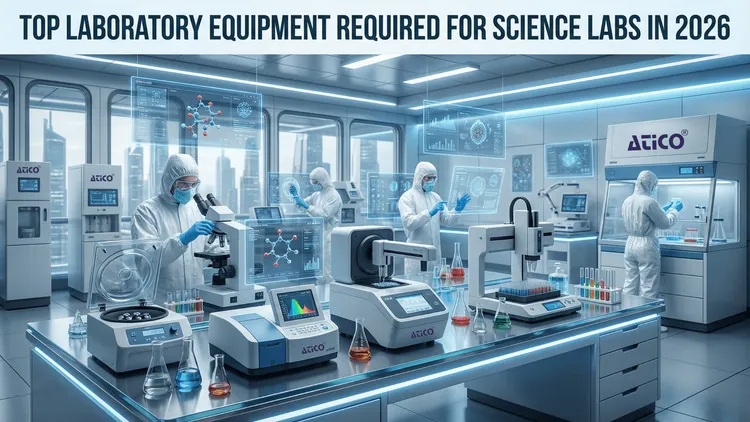
Science labs in 2026 are becoming smarter, more automated, and highly precise. Essential equipment like microscopes, centrifuges, and spectrophotometers now come with digital integration and AI-assisted features, making experiments faster and more accurate. Therefore, the right laboratory equipment in 2026 is not just about functionality, it???s about enabling smarter, safer, and more efficient scientific work.
Top Laboratory Equipment Required for Science Labs in 2026: One of the many things that you will find when you step into a modern scientific laboratory in 2026 is that laboratory equipment is no longer limited to just beakers and microscopes. A lab will be significantly more intelligent, will provide faster access to more results and be more accurate.
Therefore, it's important to choose the right laboratory equipment, because it can make a difference between an ordinary science lab and a modern science lab. To manage a research facility or to have advanced resources for your diagnostic centre, it's important to stay up to date with the Top Laboratory Equipment Required for Science Labs in 2026.
The blog will discuss the essential and Top Laboratory Equipment Required for Science Labs in 2026. You can check this blog and update your laboratory if you haven't till now.
Essential Laboratory Equipment For Modern Science Labs 2026
As science and technology continue to grow, laboratories across industries are becoming more advanced. They are getting more automated and data driven. Because of this, Modern Science Labs in 2026 must have access to high quality and advanced laboratory equipment. This will ensure more accuracy, safety, efficiency, and compliance with global standards. Whether you are performing experiments, diagnosis, or research, it is important to have proper tools to perform these activities. The use of modern technology in laboratories is now a must, regardless of whether the laboratory is a school science laboratory or an advanced forensic laboratory.
Therefore, before we explore the Top Laboratory Equipment Required for School labs, Medical Labs and Research and Development Labs in 2026, let's know about the core laboratory equipment. These laboratory equipments form the foundation of nearly every science lab. No matter which Laboratory you work at, it can be for educational, health care, research, industrial testing, or forensic science purposes, but a few basic lab equipments will form the foundation to conduct accurate experiments and collect data accurately and reliably.
Below is the list of Top Laboratory Equipment required for All Science Labs in 2026.
Microscopes
Microscopes are the most common laboratory equipment. You will spot them in every science lab. These are the fundamental instruments used to observe objects that are not visible to the naked eye. They play an important role in biology, school labs, medical diagnostics, and nanotechnology. Different types of microscopes are used in laboratories for various purposes. A few of them are the Optical Microscope, Digital Microscope, and Electron Microscope.
Centrifuges
Centrifuges are used in science labs to separate substances on the basis of their density. Centrifuges use the rapid spinning method and they are commonly used in chemistry, biology, and medical laboratories.
Key applications of Centrifuges include:
- Separation of blood components in medical labs
- Separation of DNA, RNA, and proteins in research laboratories
- Clarification of chemical and environmental samples
Modern centrifuges in 2026 have improved their features like speed control, temperature regulation, etc. it now comes with improved safety features.
Analytical Balances
Analytical balances are weighing instruments with high precision. These are used to measure very small quantities of substances with exceptional accuracy.
The important features of Analytical Balances include:
- Accurate chemical formulation
- Reliable experimental results
Laboratory Glassware
No matter how advanced science gets, it is almost impossible to replace glassware. These laboratory glassware items are used for measuring, mixing, heating, and storing chemicals and samples.
Common types include:
- Beakers: these are used for mixing and heating liquids
- Flasks: flasks are commonly used for reactions and storage
- Test tubes: they are used for small-scale experiments
- Test tubes: they are used for sample handling
Autoclaves and Sterilisers
Autoclaves and sterilisers are used to maintain hygiene. These help in preventing contamination in laboratories. They help in sterilising instruments and glassware by removing harmful microorganisms. This helps labs in meeting biosafety standards.
Digital Data Logging and Lab Management Systems
Digital transformation has become an important feature of modern laboratories. Data logging and lab management systems streamline operations and improve accuracy. Key benefits of using lab management systems include:
- Automated data capture and storage
- Reduced human error
- Improved data maintenance
9 Essential Laboratory Equipment Required for School Science Labs in 2026
A school science laboratory with all the necessary lab equipment is important in 2026. Practical experiments help students better understand scientific concepts. It becomes difficult to conduct experiments safely and properly without basic laboratory equipment. Below are the most important lab instruments every school science lab should have.
1. Microscopes: Microscopes are one of the most commonly found instruments in school labs. These are used to observe tiny organisms, cells, and objects that cannot be seen with the naked eye. Microscopes are commonly used in biology classes and are a must have in every school lab.
2. Magnifying Glasses: Magnifying glasses are simple tools mainly used in early science education. They help students examine leaves, insects, rocks and minerals and other small objects. They are ideal for primary and middle school science activities.
3. Beakers: Beakers are basic laboratory glass containers used for mixing, heating, and holding liquids. They have:
- A cylindrical shape
- A flat bottom
- A small spout for easy pouring Beakers are widely used in chemistry experiments.
4. Flasks: Flasks are used for heating, mixing, and storing liquids. Unlike beakers, flasks have a narrow neck, which reduces spills, minimises evaporation and makes swirling liquids easier. They are commonly used in chemistry practicals.
5. Test Tubes: Test tubes are small, narrow glass tubes used to hold and heat small amounts of substances. Since they have rounded bottoms, they are placed in test tube racks during experiments or storage. They are commonly used for simple chemical reactions and heating experiments.
6. Pipettes: Pipettes are used to measure and transfer small amounts of liquid accurately. They help students perform experiments that require precision. Traditional pipettes use a rubber bulb to draw liquid into a thin tube.
7. Bunsen Burners or Hot Plates: Both are used for heating substances in the laboratory. Bunsen Burners produce an adjustable open flame. Hot Plates heat substances without an open flame and are considered safer for school use. Many schools now prefer hot plates for safety reasons.
8. Thermometers: Thermometers are used to measure temperature during experiments. They help students monitor:
- Heating and cooling reactions
- Room temperature
- Liquid temperature Accurate temperature measurement is important in many scientific experiments.
9. Laboratory Scales (Balances): Laboratory scales are used to measure the mass of solids and liquids accurately. Precise measurement is essential in chemistry experiments, making lab balances a key piece of equipment in school science labs.
In addition to the main instruments above, schools may also require Funnels, Burettes, Centrifuges, Water Baths, Tongs & more.
Laboratory Equipment 2026 for Medical and Healthcare Science Labs
Medical and healthcare labs are an important part of modern healthcare systems. They help in accurate disease diagnosis, patient monitoring, treatment decisions, and preventive care. In 2026, medical laboratories must focus on three important factors: accuracy, speed, and reliability. Advanced laboratory equipment and digital systems are no longer optional; they are essential for delivering high quality patient care.
Below are the important laboratory equipment required for medical and healthcare laboratories in 2026.
Automated Haematology Analysers
Automated haematology analysers are used to examine blood samples and detect a wide range of medical conditions. These systems:
- Analyse red blood cells, white blood cells, and platelets
- Detect abnormalities with high precision
- Reduce manual errors
- Improve turnaround time
- Handle large sample volumes efficiently
They are important for routine blood tests and early disease detection.
Biochemistry Analysers
Biochemistry analysers measure chemical substances in blood and other body fluids. They test for:
- Glucose
- Cholesterol
- Enzymes
- Electrolytes
- Proteins
These analysers help diagnose conditions related to:
- Liver function
- Kidney function
- Heart health
- Metabolic disorders
Modern biochemistry systems are designed for high patient volumes and provide fast, consistent results.
PCR Machines and Molecular Diagnostic Systems
Polymerase Chain Reaction (PCR) systems are used to detect genetic material from viruses, bacteria, and patients. They are widely used for:
- Infectious disease detection
- Genetic testing
- Cancer diagnostics
- Research applications
PCR technology enables early and accurate diagnosis and supports personalised medicine approaches.
Blood Gas Analysers
Blood gas analysers are important in emergency and critical care settings. They measure:
- Oxygen levels
- Carbon dioxide levels
- Blood pH
- Electrolytes
These instruments provide rapid results, which is important in intensive care units (ICUs) and emergency departments for monitoring respiratory and metabolic conditions.
Laboratory Information Management Systems (LIMS)
A Laboratory Information Management System (LIMS) is a digital platform that manages laboratory data and workflows. LIMS helps to:
- Track samples from collection to reporting
- Store and manage patient data securely
- Integrate results with hospital information systems
- Ensure regulatory compliance
- Reduce paperwork and human errors
Top Laboratory Equipment for Research and Development (R&D) Labs Required in 2026
Research and Development (R&D) laboratories are at the centre of scientific innovation, product improvement, and technological progress. In 2026, R&D labs must operate with high precision, advanced automation, and reliable analytical systems.
These laboratories support industries such as pharmaceuticals, biotechnology, materials science, electronics, and data driven research. To remain competitive, R&D facilities must invest in modern, high performance laboratory equipment.
Below is the top laboratory equipment required for R&D labs in 2026.
High Resolution Electron Microscopes
Electron microscopes are essential for advanced research that requires ultra high magnification. They allow researchers to:
- Visualise nanostructures and microscopic surfaces
- Study cellular structures in detail
- Analyse semiconductor and material surfaces
- Conduct nanotechnology research
Unlike optical microscopes, electron microscopes provide extremely detailed imaging at the nanoscale level, making them critical for cutting edge research.
Chromatography Systems (HPLC and GC MS)
Chromatography systems are used to separate, identify, and measure chemical compounds. High Performance Liquid Chromatography (HPLC) are widely used in pharmaceutical and biochemical research. These are essential for drug development and formulation analysis. They provide accurate quantification of compounds. Gas Chromatography Mass Spectrometry (GC MS) are used for compound identification. They support purity testing and chemical profiling. They are commonly used in environmental and forensic analysis. Modern chromatography systems in 2026 offer improved sensitivity, faster processing times, and higher automation for large research volumes.
Spectroscopy Instruments
Spectroscopy equipment analyses how matter interacts with electromagnetic radiation. Common spectroscopy techniques include:
- UV Visible (UV Vis) Spectroscopy
- Infrared (IR) Spectroscopy
- Nuclear Magnetic Resonance (NMR)
- Raman Spectroscopy
These instruments are used for:
- Molecular structure analysis
- Material characterisation
- Chemical composition studies
Spectroscopy tools are widely used in chemistry, biotechnology, physics, and advanced materials research.
Cell Culture Equipment and Incubators
Cell culture systems are fundamental in life sciences and pharmaceutical research. They help researchers:
- Grow and maintain cells in controlled environments
- Conduct drug testing and toxicity studies
- Perform tissue engineering and genetic research
Essential equipment includes:
- Biosafety cabinets
- CO??? incubators
- Culture monitoring systems
Maintaining sterile conditions and precise environmental control is critical for reliable results.
Robotics and Automated Liquid Handling Systems
Automation plays a major role in modern R&D laboratories. Robotic liquid handling systems:
- Ensure precise and repeatable sample preparation
- Reduce human error
- Increase productivity and throughput
- Support high throughput screening
Automation is especially valuable for large scale experiments, pharmaceutical research, and complex testing workflows.
How to Choose Science Laboratory Equipment 2026
It is important to choose the right laboratory equipment for science labs to create a safe, effective, and future ready learning environment. As regulations and safety standards evolve and become stricter, schools and institutions must focus not only on availability but also on quality, safety, durability, and long term value.
Below are the key factors to consider when selecting science laboratory equipment.
Understand Your Laboratory Requirements
You must start by identifying the subjects and grade levels the laboratory will support. Different science disciplines require different equipment:
- Biology labs may need microscopes, slides, centrifuges, and specimen tools.
- Chemistry labs require glassware, burners or hot plates, measuring instruments, and safety tools.
- Physics labs may need electrical kits, measuring devices, and experimental apparatus.
The equipment you choose should match the curriculum and allow students to perform both basic experiments and advanced practical work.
Prioritise Safety Standards
Safety must always be the top priority in any science laboratory. When selecting lab equipment:
- You must choose heat resistant and chemical resistant materials.
- Always look for safety certified products.
- Make sure that equipment has stable bases and proper insulation.
- Don't forget to include protective tools such as tongs, racks, safety shields, and gloves.
- Where possible, consider flame free alternatives like hot plates and water baths instead of open flame burners to reduce risk.
- High quality equipment helps create a safer learning environment for both students and teachers.
- Make sure that the equipments are designed and manufactured according to the national and international standards.
Focus on Accuracy and Reliability
Accurate measurements are essential in scientific experiments. Select instruments such as:
- Laboratory balances
- Burettes and pipettes
- Thermometers
- Measuring cylinders
Reliable and precise equipment ensures consistent results and helps students learn proper scientific techniques.
Consider Durability and Build Quality
School laboratory equipment is used frequently. It must withstand regular handling. You must look for:
- Strong, high quality glassware
- Corrosion resistant metals
- Durable plastic components
- Scratch resistant surfaces
Investing in durable equipment reduces replacement costs and ensures long term usability.
Choose Equipment That Is Easy to Maintain
Maintenance and storage are often overlooked but are very important. Select equipment that:
- Is easy to clean
- Has simple calibration procedures
- Has minimal complex moving parts
- Fits properly into storage cabinets or racks
Easy maintenance saves time and ensures the laboratory remains organised and safe.
Balance Budget with Long Term Value
While budget limitations are common, the lowest price is not always the best option. Instead of focusing only on cost, consider:
- Product lifespan
- Warranty support
- Maintenance requirements
- Replacement frequency
High quality equipment may cost more initially but often saves money in the long run.
Ensure Future Readiness
Modern science labs should be adaptable to future developments. Consider incorporating:
- Digital thermometers
- Electronic pipettes
- Data enabled balances
- Smart laboratory devices
Introducing students to modern scientific tools prepares them for higher education and future careers.
Choosing the right laboratory equipment for science labs requires careful planning and attention to safety, quality, durability, and future needs. A well equipped lab not only supports effective teaching but also builds students??? confidence in scientific experimentation.
If you are planning a laboratory upgrade, need guidance on equipment maintenance, or want to invest in sustainable and long lasting lab instruments, working with experienced laboratory equipment specialists can help ensure the best results for your institution.