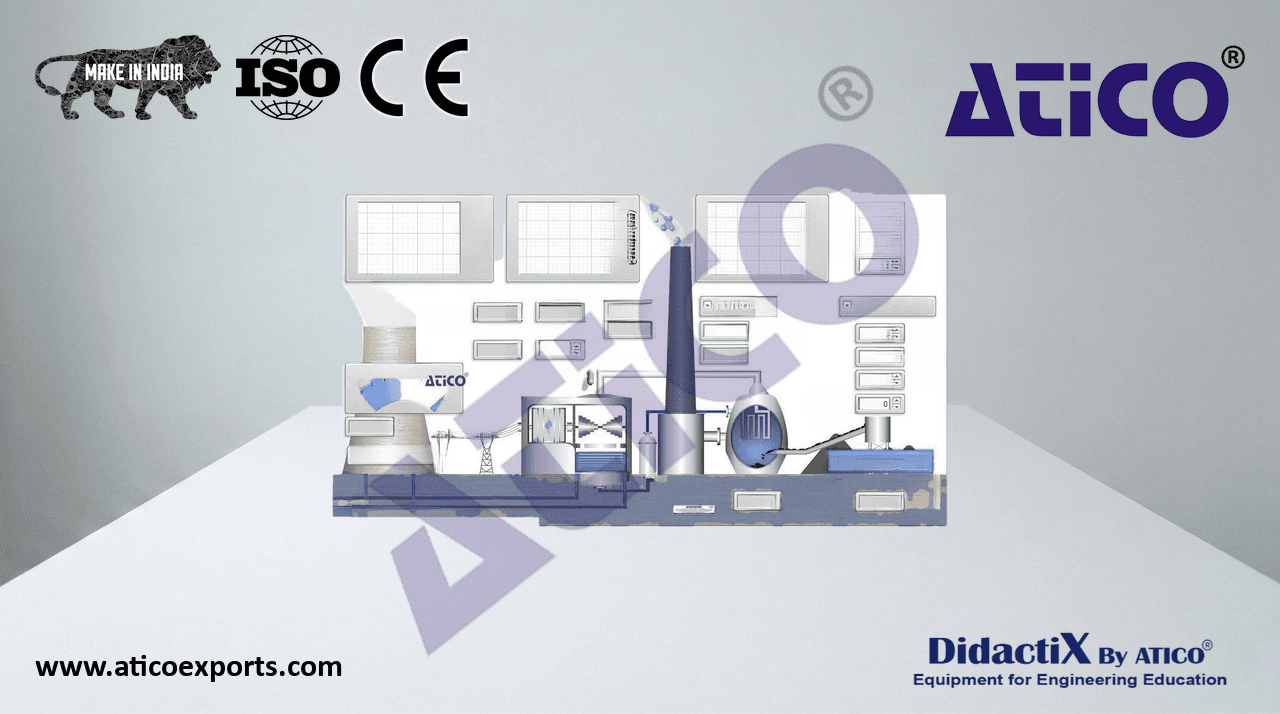
ATENG 11527 — Computer Controlled Tidal Energy Unit
(for main items)
- With this unit there are several options and possibilities:
- Main items: 1, 2, 3, 4, 5 and 6.
- Optional items: 7, 8, 9, 10 and 11.
- Let us describe first the main items (1 to 6):
- 1EMMC. Unit:
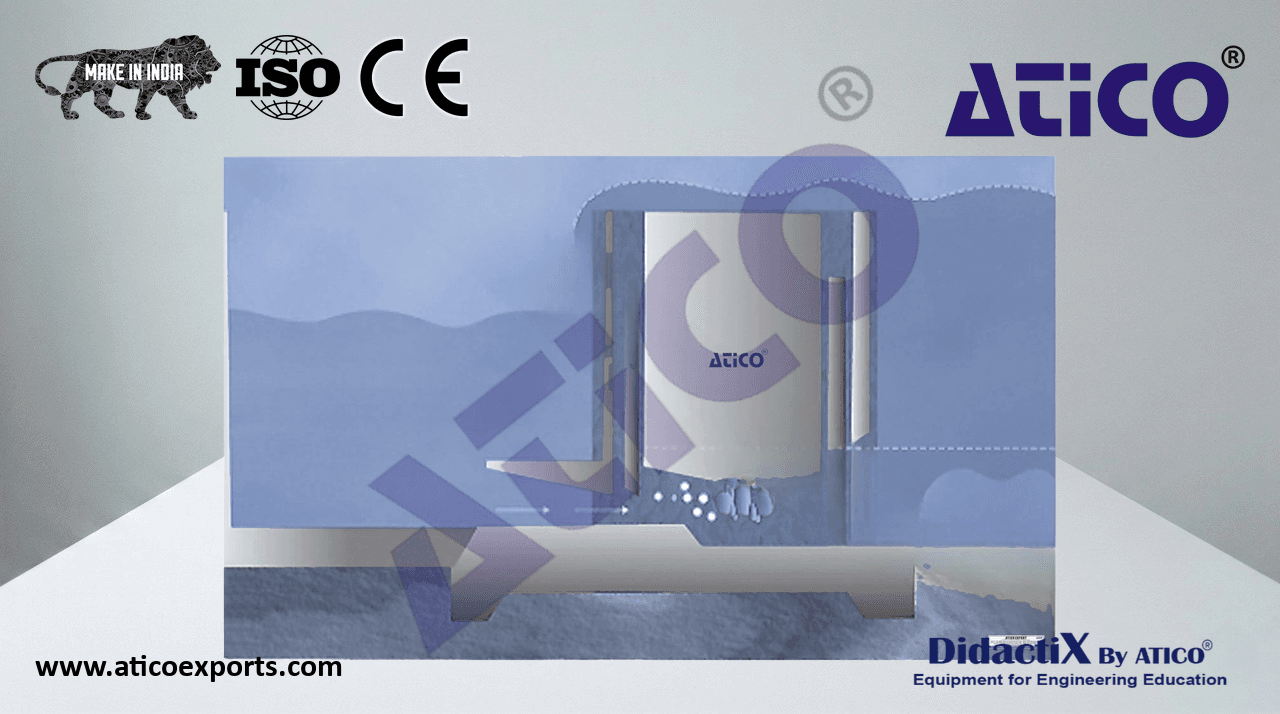
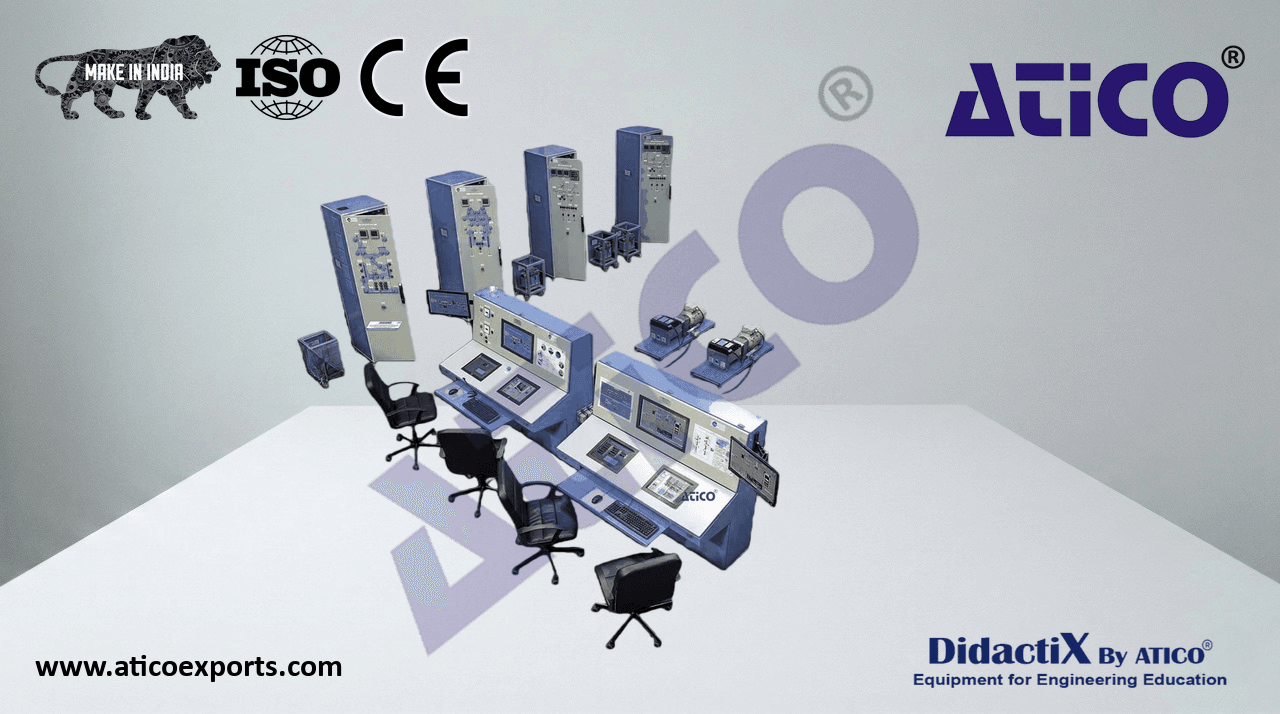
Unit designed for simulating a tidal barrage energy generation system.
Anodized aluminum frame and panels made of painted steel.
Main metallic elements made of stainless steel.
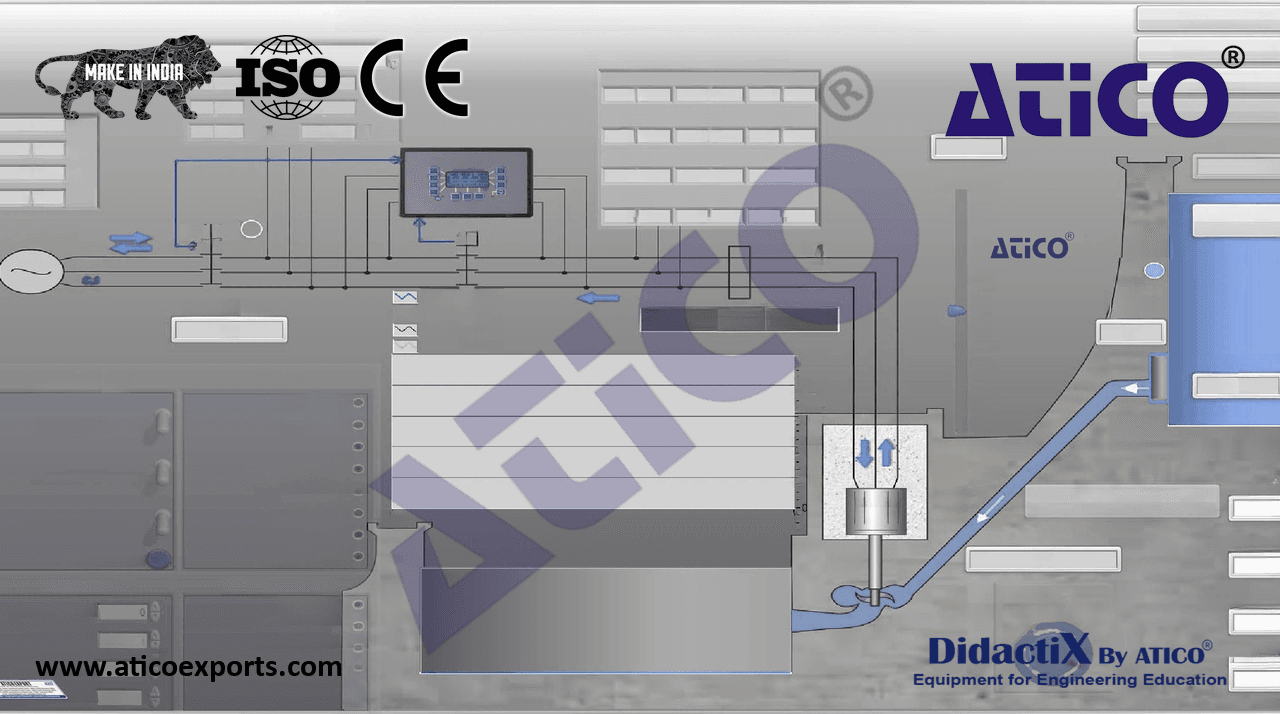
Diagram in the front panel with distribution of the elements
similar to the real one.
- The unit is formed by the following main elements:
Two transparent working sections to be filled with water.
Water pump, computer controlled.
Turbine-generator.
- Four pressure sensors:
Two pressure sensors for measuring the water volume.
Orifice plate with two pressure sensors for measuring the flow.
DC loads module.
Power measurement from the computer.
- The complete unit includes as well:
- Unit: ATENG 11527
Advanced Real-Time SCADA.
Open Control + Multicontrol + Real-Time Control.
Specialized Control Software based on LabVIEW.
National Instruments Data Acquisition board (250 KS/s, kilo samples per second).
Calibration exercises, which are included, teach the user how to calibrate a sensor and the
importance of checking the accuracy of the sensors before taking measurements.
Projector and/or electronic whiteboard compatibility allows the unit to be explained and
demonstrated to an entire class at one time.
Capable of doing applied research, real industrial simulation, training courses, etc.
Remote operation and control by the user, as well as remote support from technical
support, are always included.
Totally safe, utilizing 4 safety systems (Mechanical, Electrical, Electronic & Software).
Designed and manufactured under several quality standards.
Optional ICAI software to create, edit and carry out practical exercises, tests, exams,
calculations, etc. Apart from monitoring user's knowledge and progress reached.
This unit has been designed for future expansion and integration. A common expansion is
the Scada-Net (ESN) System which enables multiple students to simultaneously
operate many units in a network.
- EMMC/CIB. Control Interface Box:
The Control Interface Box is part of the SCADA system.
Control interface box with process diagram in the front panel and with the same distribution that
the different elements located in the unit, for an easy understanding by the student.
- All sensors, with their respective signals, are properly manipulated from -10V. to +10V. computer output.
Sensors connectors in the interface have different pines numbers (from 2 to 16), to avoid
connection errors.
Single cable between the control interface box and computer.
The unit control elements are permanently computer controlled, without necessity of
changes or connections during the whole process test procedure.
Simultaneous visualization in the computer of all parameters involved in the process.
Calibration of all sensors involved in the process.
Real time curves representation about system responses.
Storage of all the process data and results in a file.
Graphic representation, in real time, of all the process/system responses.
All the actuators’ values can be changed at any time from the keyboard allowing the
analysis about curves and responses of the whole process.
All the actuators and sensors values and their responses are displayed on only one screen in the
computer.
Shield and filtered signals to avoid external interferences.
Real time computer control with flexibility of modifications from the computer keyboard
of the parameters, at any moment during the process. EMMC/CIB
Real time computer control for pumps, compressors, heating elements, control valves, etc.
Real time computer control for parameters involved in the process simultaneously.
Open control allowing modifications, at any moment and in real time, of parameters involved in the
process simultaneously.
Three safety levels, one mechanical in the unit, another electronic in the control interface and
the third one in the control software.
3
Complete Technical Specifications (for main items)
- 3 DAB. Data Acquisition Board:
The Data Acquisition board is part of the SCADA system.
PCI Express Data acquisition board (National Instruments) to be placed in a computer slot. Bus
PCI Express.
- Analog input:
Number of channels= 16 single-ended or 8 differential. Resolution=16 bits, 1 in 65536.
- Sampling rate up to: 250 KS/s (kilo samples per second).
- Input range (V)=±10 V. Data transfers=DMA, interrupts, programmed I/0. DMA channels=6.
- Analog output:
Number of channels=2. Resolution=16 bits, 1 in 65536.
- Maximum output rate up to: 900 KS/s.
- Output range (V)=±10 V. Data transfers=DMA, interrupts, programmed I/0. DAB
- Digital Input/Output:
- Number of channels=24 inputs/outputs. D0 or DI Sample Clock frequency: 0 to 100 MHz.
- Timing: Number of Counter/timers=4. Resolution: Counter/timers: 32 bits.
The Data Acquisition board model may change at any moment, providing the same or better
features than those required for the unit.
- 4 EMMC/CCSOF. Computer Control + Data Acquisition + Data Management Software:
The three softwares are part of the SCADA system.
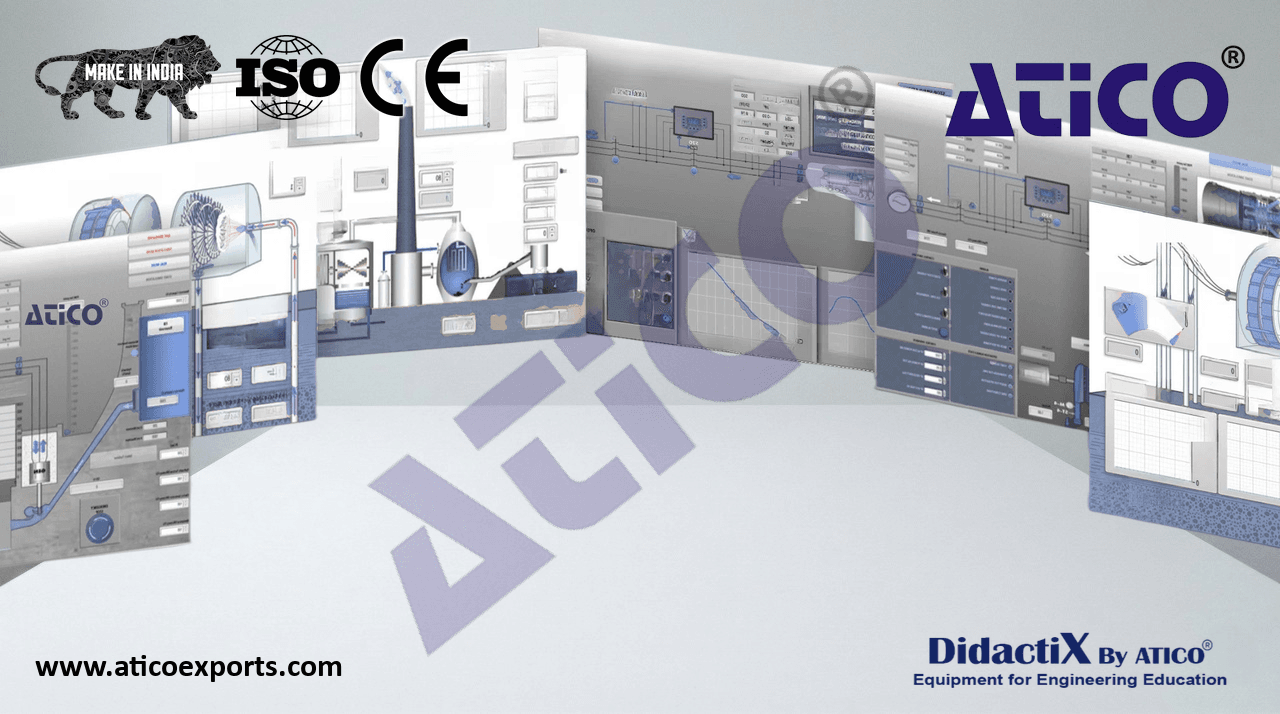
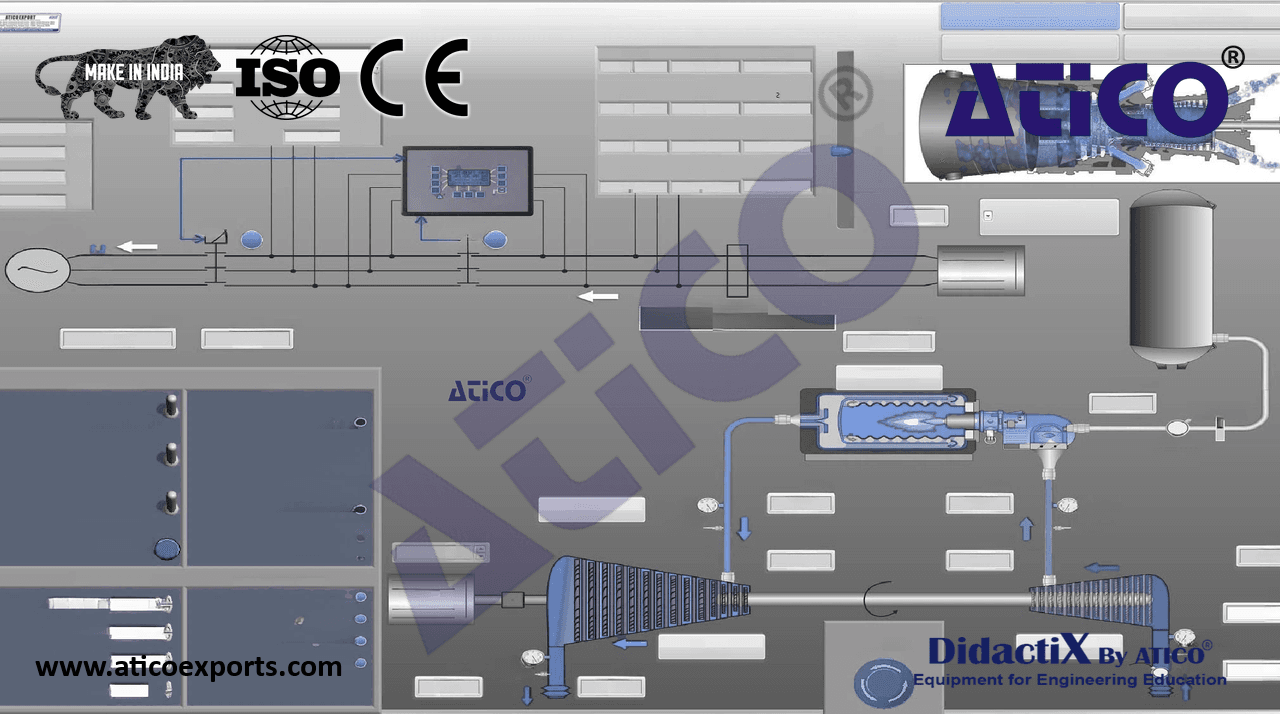
Compatible with actual Windows operating systems. Graphic and intuitive simulation of the process in
screen. Compatible with the industry standards.
Registration and visualization of all process variables in an automatic and simultaneous way.
Flexible, open and multicontrol software, developed with actual windows graphic systems, acting
simultaneously on all process parameters.
Management, processing, comparison and storage of data.
Sampling velocity up to 250 KS/s (kilo samples per second).
Calibration system for the sensors involved in the process.
It allows the registration of the alarms state and the graphic representation in real time.
Comparative analysis of the obtained data, after the process and modification of the conditions during
EMMC/CCSOF
the process.
Open software, allowing the teacher to modify texts, instructions. Teacher’s and student’s
passwords to facilitate the teacher’s control on the student, and allowing the access to different work
levels.
This unit allows the 30 students of the classroom to visualize simultaneously all the results
and the manipulation of the unit, during the process, by using a projector or an electronic
whiteboard.
5 Cables and Accessories, for normal operation.
- 6Manuals:
- This unit is supplied with 8 manuals: Required services, Assembly and Installation, Interface and
Control software, Starting-up, Safety, Maintenance, Calibration & Practices manuals.
- References 1 to 6 are the main items: ATENG 11527 + EMMC/CIB + DAB + EMMC/CCSOF + Cables and Accessories + Manuals are
included in the minimum supply for enabling normal and full operation.
4
COMPLETE TECHNICAL SPECIFICATIONS (for optional items)
Additionally to the main items (1 to 6) described, we can offer, as optional, other items from 7 to 11.
- All these items try to give more possibilities for:
a) Industrial configuration. (PLC)
b) Technical and Vocational Education configuration. (ICAI and FSS)
c) Multipost Expansions options. (MINI ESN and ESN)
a) Industrial configuration
- 7PLC. Industrial Control using PLC (it includes PLC-PI Module plus PLC-SOF Control Software):
- PLC-PI. PLC Module:
Metallic box.
Circuit diagram in the module front panel.
- Front panel:
- Digital inputs (X) and Digital outputs (Y) block:
16 Digital inputs, activated by switches and 16 LEDs for confirmation (red).
14 Digital outputs (through SCSI connector) with 14 LEDs for message (green).
- Analog inputs block:
- 16 Analog inputs (-10 V. to + 10 V.) (through SCSI connector).
- Analog outputs block:
- 4 Analog outputs (-10 V. to + 10 V.) (through SCSI connector).
- Touch screen:
High visibility and multiple functions. Display of a highly visible status. Recipe function. Bar graph function. Flow display function. Alarm list.
Multi language function. True type fonts.
- Back panel:
- Power supply connector. Fuse 2A. RS-232 connector to PC. USB 2.0 connector to PC.
- Inside:
- Power supply outputs: 24 Vdc, 12 Vdc, -12 Vdc, 12 Vdc variable.
- Panasonic PLC:
High-speed scan of 0.32 µsec. for a basic instruction.
Program capacity of 32 Ksteps, with a sufficient comment area.
- Power supply input (100 to 240 V AC).
- DC input: 16 (24 V DC).
- Relay output: 14.
High-speed counter.
Multi-point PID control.
Digital inputs/outputs and analog inputs/outputs Panasonic modules.
Communication RS232 wire to computer (PC).
- Dimensions: 490 x 330 x 310 mm. approx. (19.29 x 12.99 x 12.20 inches approx.). Weight: 30 Kg. approx. (66 pounds approx.).
- EMMC/PLC-SOF. PLC Control Software:
For this particular unit, always included with PLC supply.
The software has been designed using Labview and it follows the unit operation procedure and linked with the Control Interface Box used in the Computer
Controlled Tidal Energy Unit (ATENG 11527).
- Control Interface Data Software for:
- Box Acquisition - Computer Control
- Unit Board - Data Acquisition
- Data Management
PLC CONTROL
PLC-SOF.
Control Software
PLC-PI. PLC Module
- Practices to be done with PLC-PI:
1.- Control of the particular unit process through the control interface box 13.-PLC different programming standard languages (ladder diagram (LD),
without the computer. structured text (ST), instructions list (IL), sequential function chart (SFC),
2.- Visualization of all the sensors values used in the particular unit process. function block diagram (FBD)).
3.- Calibration of all sensors included in the particular unit process. 14.-New configuration and development of new process.
4.- Hand on of all the actuators involved in the particular unit process. 15.-Hand on an established process.
5.- Realization of different experiments, in automatic way, without having in 16.-To visualize and see the results and to make comparisons with the
front the particular unit. (These experiments can be decided previously). particular unit process.
6.- Simulation of outside actions, in the cases do not exist hardware 17.-Possibility of creating new process in relation with the particular unit.
- elements. (Example: test of complementary tanks, complementary 18.-PLC Programming Exercises.
industrialenvironment to the process to be studied, etc). 19.-Own PLC applications in accordance with teacher and student
7.- PLC hardware general use. requirements.
8.- PLC process application for the particular unit.
9.- PLC structure.
10.-PLC inputs and outputs configuration.
11.-PLC configuration possibilities.
12.-PLC program languages.
6
Complete Technical Specifications (for optional items)
b) Technical and Vocational Education configuration
8 EMMC/ICAI. Interactive Computer Aided Instruction Software.
- This complete software package consists of an Instructor Software ( Classroom Manager - ECM-SOF) totally integrated with the
- Student Software ( Student Labsoft - ESL-SOF). Both are interconnected so that the teacher knows at any moment what is the theoretical and
practical knowledge of the students.
This software is optional and can be used additionally to items (1 to 6).
Instructor Software
- ECM-SOF. Classroom Manager (Instructor Software).
ECM-SOF is the application that allows the Instructor to register students,
manage and assign tasks for workgroups, create own content to carry out
Practical Exercises, choose one of the evaluation methods to check the
Student knowledge and monitor the progression related to the planned
tasks for individual students, workgroups, units, etc. so the teacher
can know in real time the level of understanding of any student in the
classroom.
- Innovative features: ECM-SOF. Classroom
Manager (Instructor Software)
- User Data Base Management. Application Main Screen ECAL. Calculations Program Package -
Formula Editor Screen
- Administration and assignment of Workgroup, Task and Training
sessions.
- Creation and Integration of Practical Exercises and Multimedia
Resources.
- Custom Design of Evaluation Methods.
- Creation and assignment of Formulas & Equations.
- Equation System Solver Engine.
- Updatable Contents.
ERS. Results & Statistics
- Report generation, User Progression Monitoring and Statistics. Program Package - Student
Scores Histogram ETTE. Training Test & Exam Program
- Package - Main Screen with Numeric Result
Question
- ESL-SOF. Student Labsoft (Student Software).
ESL-SOF is the application addressed to the Students that helps them Student Software
to understand theoretical concepts by means of practical exercises
and to prove their knowledge and progression by performing tests and
calculations in addition to Multimedia Resources. Default planned tasks
and an Open workgroup are provided by to allow the students
start working from the first session. Reports and statistics are available
to know their progression at any time, as well as explanations for every
exercise to reinforce the theoretically acquired technical knowledge.
- Innovative features:
- Student Log-In & Self-Registration.
ESL-SOF. Student
LabSoft (Student Software)
- Existing Tasks checking & Monitoring.
Application Main Screen
EPE. Practical Exercise Program Package
- Default contents & scheduled tasks available to be used from the Main Screen
first session.
- Practical Exercises accomplishment by following the Manual
provided
- Evaluation Methods to prove your knowledge and progression.
- Test self-correction.
- Calculations computing and plotting.
- Equation System Solver Engine.
- User Monitoring Learning & Printable Reports.
ERS. Results & Statistics
- Multimedia-Supported auxiliary resources. Program Package - Question
Explanation
ECAL. Calculations Program Package
Main Screen
- For more information see ICAI catalogue. Click on the following link:
7
Complete Technical Specifications (for optional items)
9 EMMC/FSS. Faults Simulation System.
Example of some screens
Faults Simulation System (FSS) is a Software package that simulates
several faults in any Computer Controlled Unit. It is useful for
Technical and Vocational level.
The “FAULTS” mode consists in causing several faults in the unit
normal operation. The student must find them and solve them.
There are several kinds of faults that can be grouped in the following
- sections:
- Faults affecting the sensors measurement:
- An incorrect calibration is applied to them.
- Non-linearity.
- Faults affecting the actuators:
- Actuators channels interchange at any time during the program
execution.
- Response reduction of an actuator.
- Faults in the controls execution:
- Inversion of the performance in ON/OFF controls.
- Reduction or increase of the calculated total response.
- The action of some controls is annulled.
- On/off faults:
- Several on/off faults can be included.
- For more information see FSS catalogue. Click on the following link:
c) Multipost Expansions options
10MINI ESN. Mini Scada-Net System for being used with
Teaching Units.
MINI ESN.
MINI ESN. Mini Scada-Net System allows up to 30 students to work Mini Scada-Net System
with a Teaching Unit in any laboratory, simultaneously. It is useful for both,
Higher Education and/or Technical and Vocational Education.
The MINI ESN system consists of the adaptation of any Computer
Controlled Unit with SCADA integrated in a local network.
1 UNIT= up to 30
This system allows to view/control the unit remotely, from any computer
STUDENTS can work
integrated in the local net (in the classroom), through the main computer
simultaneously
connected to the unit. Then, the number of possible users who can work with
the same unit is higher than in an usual way of working (usually only one).
- Main characteristics:
- It allows up to 30 students to work simultaneously with the
Computer Controlled Unit with SCADA, connected in a local net.
Computer Controlled Tidal Energy Unit (ATENG 11527)
- Open Control + Multicontrol + Real Time Control + Multi Student
Post.
- Instructor controls and explains to all students at the same time. Software for:
- Control - Computer Control
- Any user/student can work doing “real time” control/multicontrol Interface Box - Data Acquisition
- and visualisation. - Data Management
- Instructor can see in the computer what any user/student is doing in
the unit. Instructors'
Central Mini Scada-Net
- Continuous communication between the instructor and all the Computer
users/students connected. Software
- Main advantages:
- It allows an easier and quicker understanding. LOCAL NET FOR 30 STUDENTS
- This system allows you can save time and cost.
- Future expansions with more Units.
- Note: The MINI ESN
system can be used with
any computer
controlled unit
- For more information see MINI ESN catalogue. Click on the following link:
11ESN. Scada-Net Systems.
This unit can be integrated, in the future, into a Complete Laboratory with many Units and many Students.
- For more information see ESN catalogue. Click on the following link:
8
TENDER SPECIFICATIONS (for main items)
- 1EMMC. Unit:
Unit designed for simulating a tidal barrage energy generation system.
Anodized aluminum frame and panels made of painted steel.
Main metallic elements made of stainless steel.
Diagram in the front panel with distribution of the elements similar to the real one.
- The unit is formed by the following main elements:
Two transparent working sections to be filled with water.
Water pump, computer controlled.
Turbine-generator.
- Four pressure sensors:
Two pressure sensors for measuring the water volume.
Orifice plate with two pressure sensors for measuring the flow.
DC loads module.
Power measurement from the computer.
- The complete unit includes as well:
Advanced Real-Time SCADA.
Open Control + Multicontrol + Real-Time Control.
Specialized Control Software based on LabVIEW.
National Instruments Data Acquisition board (250 KS/s, kilo samples per second).
Calibration exercises, which are included, teach the user how to calibrate a sensor and the importance of checking the accuracy of the sensors before
taking measurements.
Projector and/or electronic whiteboard compatibility allows the unit to be explained and demonstrated to an entire class at one time.
Capable of doing applied research, real industrial simulation, training courses, etc.
Remote operation and control by the user, as well as remote support from technical support, are always included.
Totally safe, utilizing 4 safety systems (Mechanical, Electrical, Electronic & Software).
Designed and manufactured under several quality standards.
Optional ICAI software to create, edit and carry out practical exercises, tests, exams, calculations, etc. Apart from monitoring user's knowledge and
progress reached.
This unit has been designed for future expansion and integration. A common expansion is the Scada-Net (ESN) System which enables multiple
students to simultaneously operate many units in a network.
- 2EMMC/CIB. Control Interface Box:
The Control Interface Box is part of the SCADA system.
Control interface box with process diagram in the front panel.
The unit control elements are permanently computer controlled.
Simultaneous visualization in the computer of all parameters involved in the process.
Calibration of all sensors involved in the process.
Real time curves representation about system responses.
All the actuators’ values can be changed at any time from the keyboard allowing the analysis about curves and responses of the whole process.
Shield and filtered signals to avoid external interferences.
Real time computer control with flexibility of modifications from the computer keyboard of the parameters, at any moment during the process.
Real time computer control for parameters involved in the process simultaneously.
Open control allowing modifications, at any moment and in real time, of parameters involved in the process simultaneously.
Three safety levels, one mechanical in the unit, another electronic in the control interface and the third one in the control software.
- 3DAB. Data Acquisition Board:
The Data Acquisition board is part of the SCADA system.
PCI Express Data acquisition board (National Instruments) to be placed in a computer slot.
- Analog input: Channels= 16 single-ended or 8 differential. Resolution=16 bits, 1 in 65536. Sampling rate up to: 250 KS/s (kilo samples per second).
- Analog output: Channels=2. Resolution=16 bits, 1 in 65536.
- Digital Input/Output: Channels=24 inputs/outputs.
The Data Acquisition board model may change at any moment, providing the same or better features than those required for the unit.
- 4EMMC/CCSOF. Computer Control +Data Acquisition+Data Management Software:
The three softwares are part of the SCADA system.
Compatible with the industry standards.
Flexible, open and multicontrol software, developed with actual windows graphic systems, acting simultaneously on all process parameters.
Management, processing, comparison and storage of data.
Sampling velocity up to 250 KS/s (kilo samples per second).
Calibration system for the sensors involved in the process.
It allows the registration of the alarms state and the graphic representation in real time.
Open software, allowing the teacher to modify texts, instructions. Teacher’s and student’s passwords to facilitate the teacher’s control on the student, and
allowing the access to different work levels.
This unit allows the 30 students of the classroom to visualize simultaneously all the results and the manipulation of the unit, during the process, by using
a projector or an electronic whiteboard.
5Cables and Accessories, for normal operation.
- 6Manuals:
- This unit is supplied with 8 manuals: Required services, Assembly and Installation, Interface and Control software, Starting-up, Safety, Maintenance,
Calibration & Practices manuals.
10
Tender Specifications (for main items)